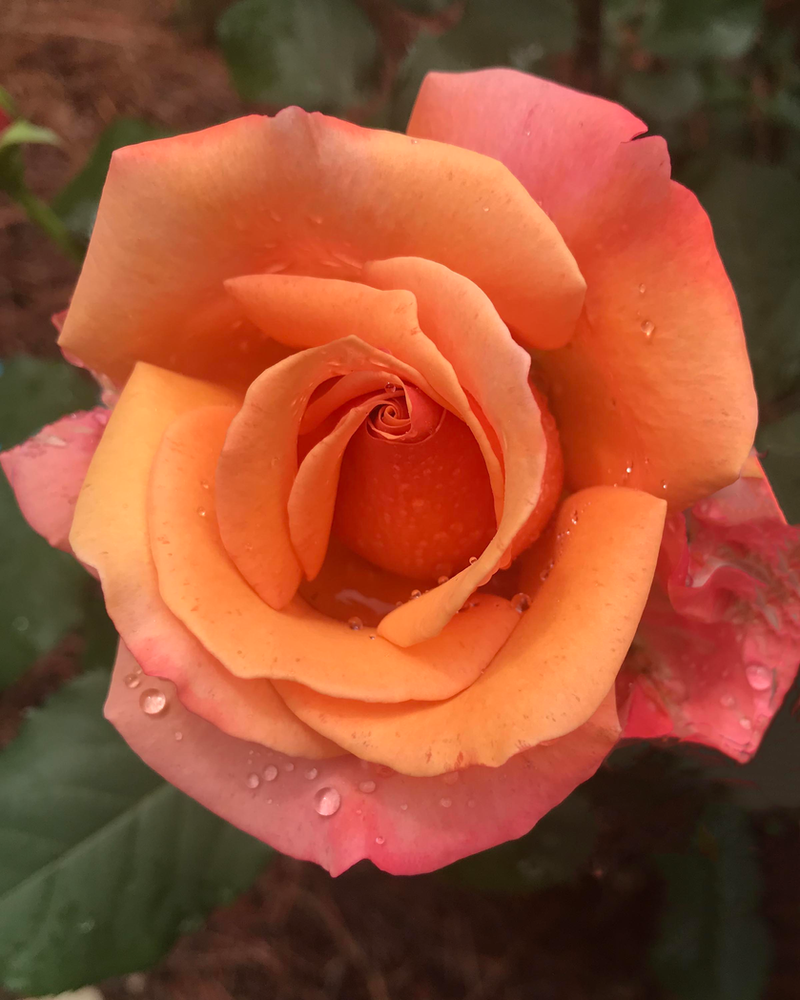
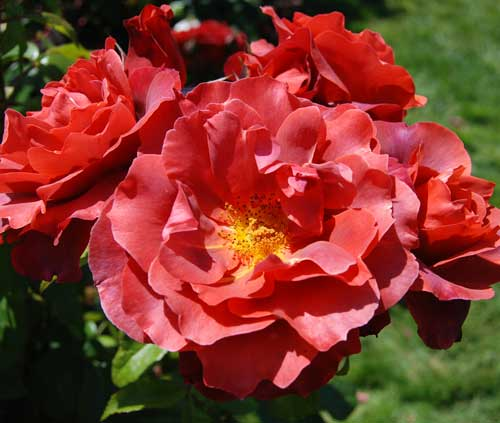
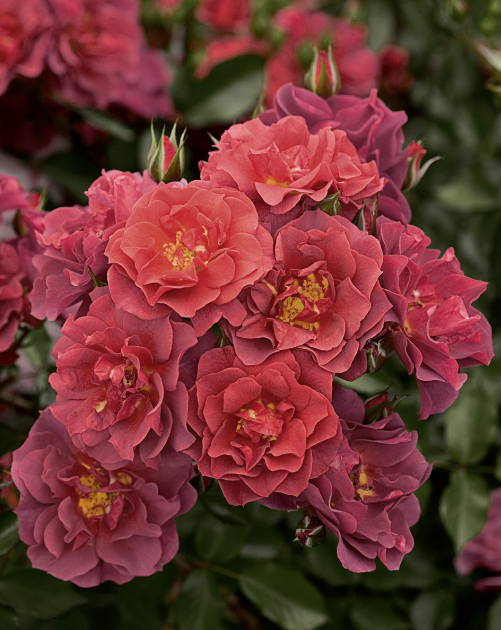
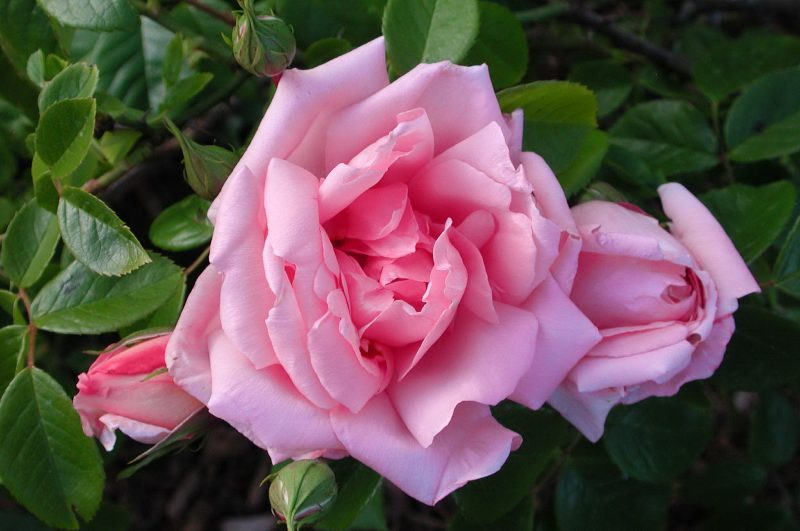
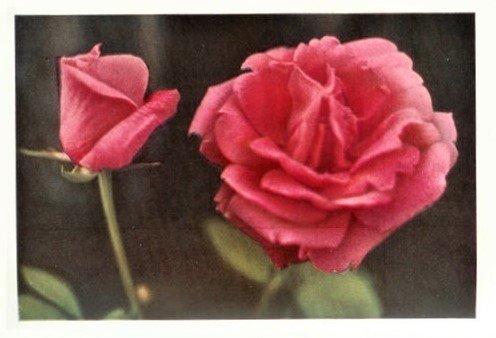
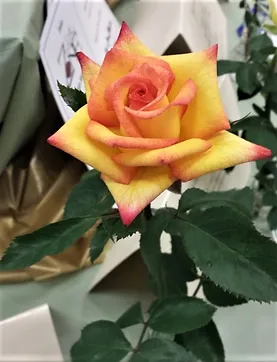
A love of roses comes to individuals in different ways. When I was a girl growing up in Baltimore, Maryland I went on a trip with my parents to Longwood Gardens in Pennsylvania. I came home with three roses ‘Peace’, ‘Chrysler Imperial’ and ‘Tropicana’ (LEFT, by Delana Jaggers). From that time on they were the favorite plant in my garden. Ask any rosarian and they will have a story about how roses came into their life. I am currently retired; however, my profession was teaching. The grade I enjoyed teaching the most was kindergarten, because they were beginners, and ready to learn so much in school. If you are new to growing roses, remember it is okay to be an enthusiastic beginner. Growing roses is a fun, exciting experience that will reap rewards in your garden. It can also be an avenue to make new friends who share your hobby.
The bulk of my rose growing experience for more than 30 years has been in Houston, Texas. As a zealous novice rose gardener, I made many mistakes. The focus of my articles will be to help you choose the right rose for you, the right place to grow it and the best ways to nurture it throughout the growing season. Let’s start at the beginning finding the right rose and the optimum location to grow your new rose.
I am often asked to give presentations to garden clubs that I call “Roses 101.” Often people tell me growing roses is too hard because roses are fussy and require lots of care. That is simply not true! Roses are easy to grow and make excellent garden plants that produce color throughout the growing season. Like any plant they have specific requirements. Making sure your rose has those requirements will help to ensure your rose growing success.
Requirement #1 – Location- Location -Location
Before deciding which rose or roses you would like to grow, you must choose the correct location. Roses require about 6-8 hours of sun daily. Find a place that meets their sun needs. Plant your roses away from trees and the canopies of trees. As the tree grows, the canopy will expand. A rose planted under a tree might be growing in sun at first. After a few years it will be in shade. Tree roots will steal water and nutrients your rose needs. Also, roses growing in too much shade will not produce many blooms and develop disease. One of the reasons for growing roses is the beautiful blooms the plant produces.
Give your rose good air circulation. Allow generous space between your rose and fences or walls and also other roses and plants. Depending on the type and size of the rose, I like to plant them on at least three-foot centers.
Requirement #2 – Pick the right rose for you
This is a topic entire books have been written about. I am going to try to keep it simple for you. Picking the wrong rose is the issue I feel that gets new rose growers in trouble, discouraging them in their new hobby. They see the beautiful hybrid teas in a florist shop or at a rose show and decide to grow them. A hybrid tea grows tall, upright and has one bloom per cane on a long stem. Hybrid teas have a bloom cycle which can be six-to-seven weeks. This means that after the first flush of blooms there is a waiting period while the plant prepares itself to bloom again. This continues throughout the growing season. As lovely as they are, they can be fussier than other kinds of roses to grow successfully, so for now wait to try them until you have more rose growing experience under your belt.
In my opinion the easiest roses that provide beginner success are floribundas, shrub roses, polyantha roses and groundcover roses. Floribundas produce roses that flower in large clusters. This means they have more than one bloom in flower at a time. Floribundas create colorful displays in the garden continually throughout the growing season. Even their name means “flowering in abundance.” These roses do well as cut flowers. One cluster can fill up a vase! ‘Europeana’ (BELOW), ‘Cinco de Mayo’ (LEFT), ‘Lavaglut’ and ‘Hot Cocoa’ (ABOVE) are floribundas that have grown well in my garden. ‘Hot Cocoa’ grew so well for me that I was continually grooming it to keep it in bounds so it would not encroach on its neighbors.
ABOVE: ‘Lavaglut’
Shrub roses are also a good choice for beginners. They are hardy, vigorous and bear large quantities of flowers throughout the growing season. Shrub roses growing in a location that they like can become very large plants spreading 5 to 15 feet in every direction. ‘Gaye Hammond’, a yellow blend was a favorite in my garden. She started out in a small pot and was moved a couple of times. When I found her happy spot, she bloomed profusely from April to November or later. Another great shrub rose in southeast Texas is ‘Belinda’s Dream’. The flowers are medium pink and the blooms have the shape of a hybrid tea. I grew this rose for a while in my garden. At one point I was redoing a bed and gave this rose to my son and his wife who had just bought their first house and wanted a rose for their sunny backyard. They took it home planted and watered it then got on with their busy lives. The next time I saw this rose it had doubled in size, was covered with beautiful pink blooms and had minimal care!
ABOVE: ‘Pretty Polly® Pink’
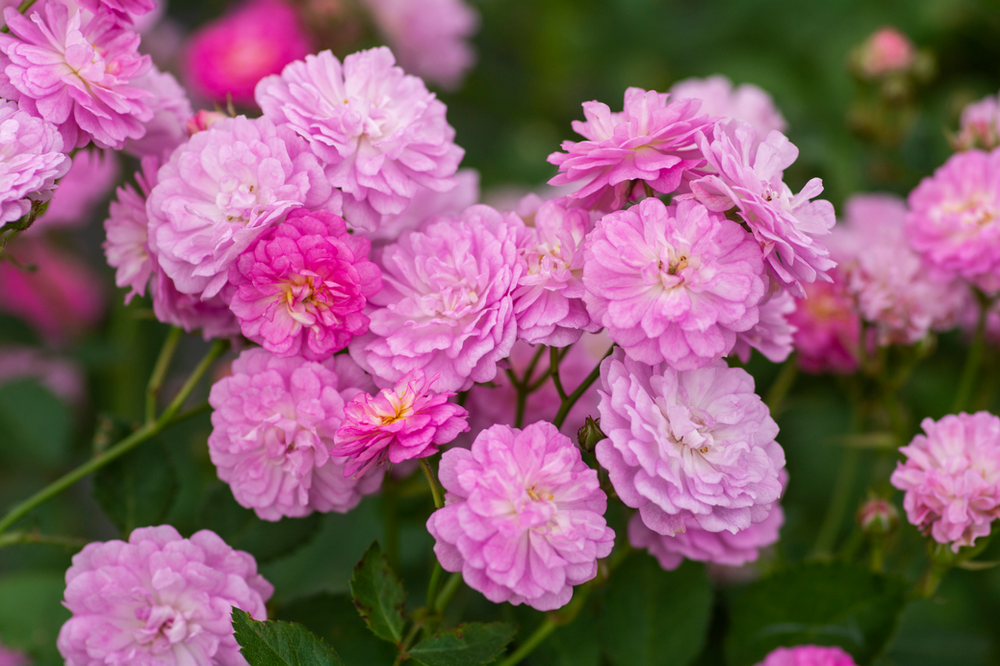
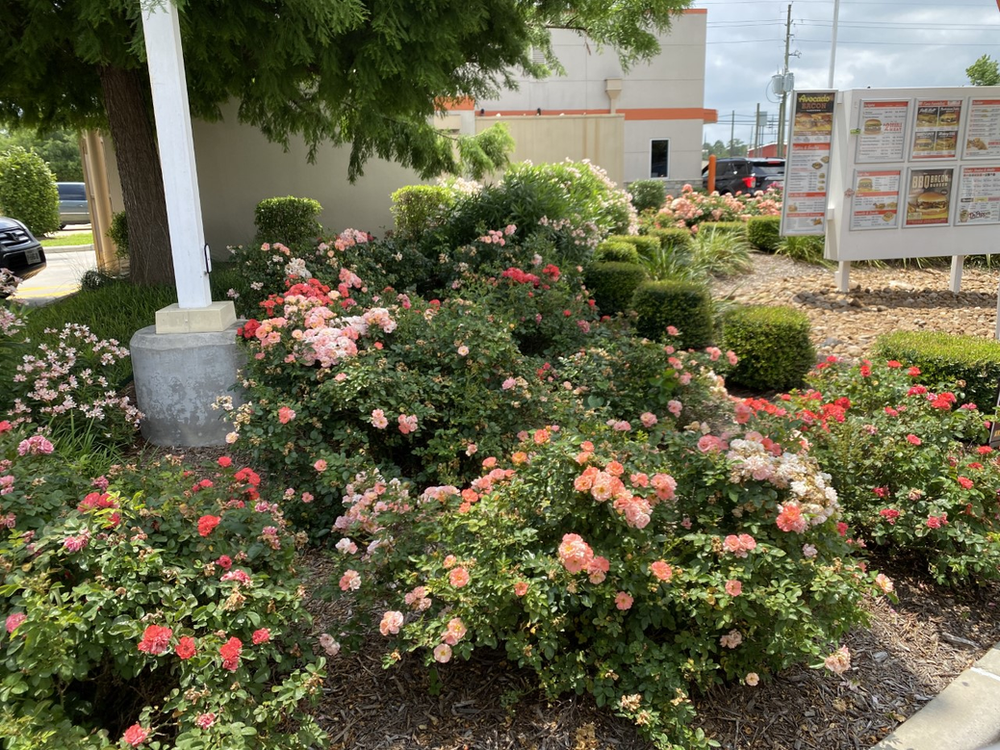
For small urban or suburban gardens polyanthas and groundcover roses can be the ticket. Polyanthas are much smaller plants than floribundas. They produce flowers in clusters about an inch in diameter. They are sturdy, hardy plants. These roses work well in small beds or containers. ‘Pretty Polly®’ roses are polyanthas that come in variety of colors pink, lavender and white. The bushes are about 2 ½’ high and 3’wide. An excellent groundcover rose I have used extensively in my garden is ‘Pink Drift®’. The ‘Drift®’ series of roses come in a rainbow of colors to choose from. Many Houston landscapers use these roses for traffic medians and other commercial uses. They are tough and robust in the heat of the Texas summer. I am always delighted to see them blooming away in spite of car exhaust and blazing sun! (LEFT: Roses at Whataburger, by Author)
Tools to Assist You in Finding the Right Rose
As you begin your rose growing journey, gaining knowledge and choosing the best roses for your garden a great place to start is to find the local rose society in your area of the country. Connect with the Consulting Rosarians in the society and find their best recommendations of roses which do well in your area. There is no charge for Consulting Rosarian services. They want to help you be a successful rose gardener.
Join the American Rose Society. The ARS website has all kinds of information on growing roses, www.rose.org. Many online programs are available. As part of your ARS membership, you will receive The Handbook for Selecting Roses. This is published yearly. It is an excellent rose buying guide. More than 3,000 varieties appear in the Handbook. Keep this with you when you go to buy roses!
Check out these websites: American Garden Rose Selections™ https://www.americangardenroseselections.com and American Rose Trials for Sustainability® https://www.americangardenroseselections.com. There are several rose trials established around the United States currently. Roses are grown and scientifically evaluated under conditions similar to where you live. They are tested for disease resistance and pest resistance. Plants featured on the websites are worthy of a place in your garden.
The Next Step
Now your homework is to take a walk around your garden/yard and evaluate where the roses you will introduce to your garden will grow the best. Remember you will need 6-8 hours of sun and stay away from those trees. Research local rose societies and peruse the websites suggested for hardy and beautiful roses that will grow in your area.
Next time I share some mistakes I have made and we will discuss how to plant those new roses you have selected for your garden!
It was the turn of a century, 19th into the 20th, when Casey would waltz with the strawberry blonde, when families and friends would picnic in the park with George or the pet dog, when Daisy would ride with her beau on a bicycle built for two, when barbershop quartets sang of romance down by the old mill stream. when roses rambled over fences, across paths, and from trees.
From the 1890s to the 1930s, rambling roses were at their height of popularity. Men like Dr. Walter van Fleet, Michael Walsh, and Rene Barbier bred them exuberantly. Why breed a mere Pernetiana or Polyantha when one could produce green mansions lavishly ornamented in cartouches of floral color (somewhat like this sentence)? And so they did. Short of writing a book on ramblers—and indeed a few have been written on the topic—this review will discuss a quintet of ramblers introduced in the first decade of the 20th century.
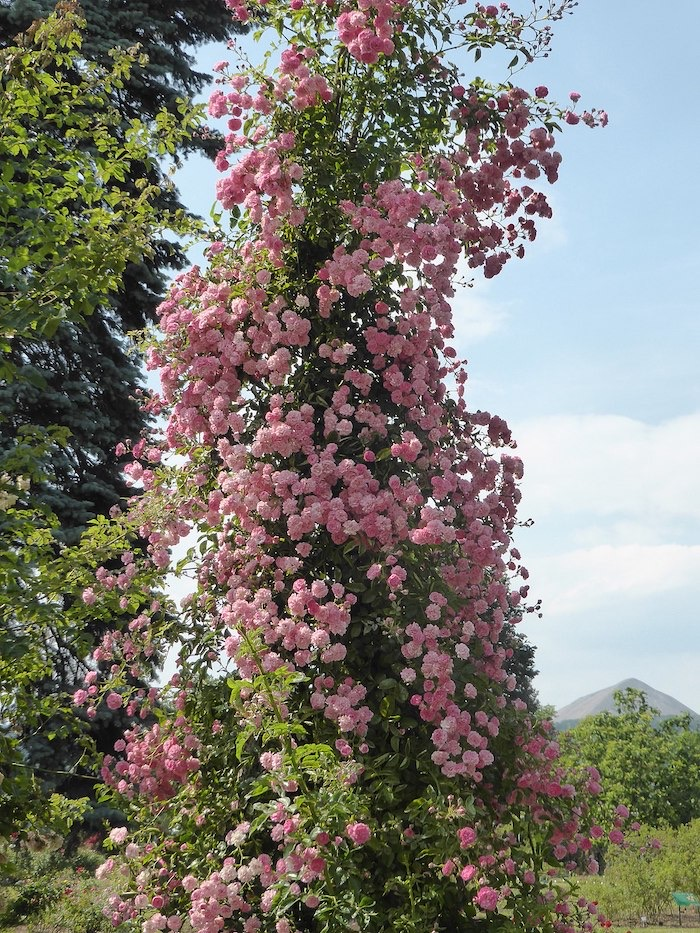
A particularly beautiful rose but one lesser known is ‘René André’ (ABOVE) of 1901, bred by Barbier, crossing Rosa wichurana with the now lost Noisette ‘L’Ideal’. Buds of saffron yellow or amber form semi-double and double flowers of a yellow-copper-pink blend or sometimes pale peachy pink. Because the outer petals fade in color first, each bloom, not being coy, exhibits contrasting shades in its several stages as it merges into its last days. The flowers share the elegant shape and color-blend of Tea roses. Occasionally they rebloom. One can detect a sweet scent—of apples, it seems. Like most Barbier roses, the plant bears very flexible canes rife with fishhook-like prickles and dark bronze-green leaves with a sheen. Though a low rambler, the canes reach out twelve to twenty feet. Because it is shade tolerant, it is good for training and trailing from trees.
While one young man René André was the son of a nurseryman friend of Barbier, another young man so named was a French swimmer on whom France pinned its hopes for the third modern Olympics held in London. Certainly he seemed to have shown promise in training. Did Barbier name the rose for his friend’s son or for the swimmer—or were they the same person? I’ve not been able to unearth the answer. Athlete René André, however, did not qualify for the semi-finals, let alone the finals.
One of four late-flowering ramblers released for the good old summertime in 1904 by Michael Walsh was ‘Minnehaha’. Of a deep yet delicate pink, the semi-globular flowers pale with age. An identifying feature is the outer petals which are not quilled, though a few of the inner petals are. Glandular bristles show noticeably on the pedicels. The serrate leaflets are elliptic-acuminate in shape. The blossoms hang in loose, often somewhat open, trusses. Sometimes mistaken for ‘Dorothy Perkins’, ‘Minnehaha’s’ flowers grow somewhat larger than those of ‘Dorothy’. Furthermore, ‘Dorothy Perkins’ shows virtually no bristles on its pedicels, and while some of its petals are quilled, others are fluted. Alluding to similarities, breeder Jack Harkness declared that Walsh’s plant “could pass for a sport of ‘Dorothy Perkins’. Rosarian George M. Taylor in 1933 preferred ‘Minnehaha’ for its “elusive charm” and its “refinement that is totally absent in ‘Dorothy Perkins’, the difference between a thoroughbred and a drayhorse.”
ABOVE: ‘Minnehaha’ by Wilrooj on WikiCommons
The name of the rose comes from Longfellow’s Ojibway saga “The Song of Hiawatha,” a poem of 1855. Minnehaha, whose name in Dakotah supposedly means Laughing Water or Waterfall, was Hiawatha’s lover who died of famine and fever in a severe Minnesota or Canadian winter. (Her death echoes the personal life of Longfellow whose first and second wives had died long before he did.)
In the Midwest where I grew up, a Minnehaha jump rope rhyme was popular among children; Baby Boomers may recall a version of it. I learned it as “Minne-Minnehaha/ went to see her papa./ Papa died/ Minne-Minne cried./ Minne had a baby/ named Dick Jim./ She put him in the bathtub/ to teach him how to swim./ He drank down the water,/ ate a bar of soap./ She took him to the doctor/ so he wouldn’t choke.” While jumping rope we counted Dick Jim’s burped soap bubbles. Many years later, I interpreted this rhyme as based partly on incestuous rape and patricide, a tragedy befitting Minnehaha’s own in the poem.
‘Alida Lovett’ (ABOVE) was bred by Dr. van Fleet, who was determined to create roses that would not demand the pampering required of Hybrid Teas. A vigorous climber of upright growth, ‘Alida Lovett’ originated as a cross between R. wichurana and ‘Souvenir du President Carnot’. Virtually without prickles, this hardy plant does not mind semi-shade. Its shiny foliage shuns mildew. The coral or shell pink roses, yellow at the base, double with reflexed petals, flower in large clusters and yield a strong perfume. They last a long time on plant and in vase.
‘Alida Lovett’ was not released until 1917 and was done so by J. T. Lovett’s Monmouth Nursery in Little Silver, New Jersey. According to one source, it was named for Lovett’s wife. (Perhaps he had met her down by the old mill stream.) Dr. van Fleet also bred ‘Bess Lovett’ and ‘Mary Lovett’, both ramblers, said to be named for Alida’s sisters. However, it seems odd, even improbable, that the sisters (now apparently sisters-in-law) should bear the same surname as Alida and her husband. On the other hand, between 1899 and 1917 three different ‘Mrs. Lovett’ roses were produced, one still being offered in 1919 but none two years later. So why name yet another for his wife? It would seem to me, then, that all three—Alida, Bess, and Mary—were not only sisters but also children of Mr. & Mrs. Lovett. (Since first writing this article, I have found confirmation for my supposition in Lovett’s own nursery catalogue; indeed, the three are sisters.)
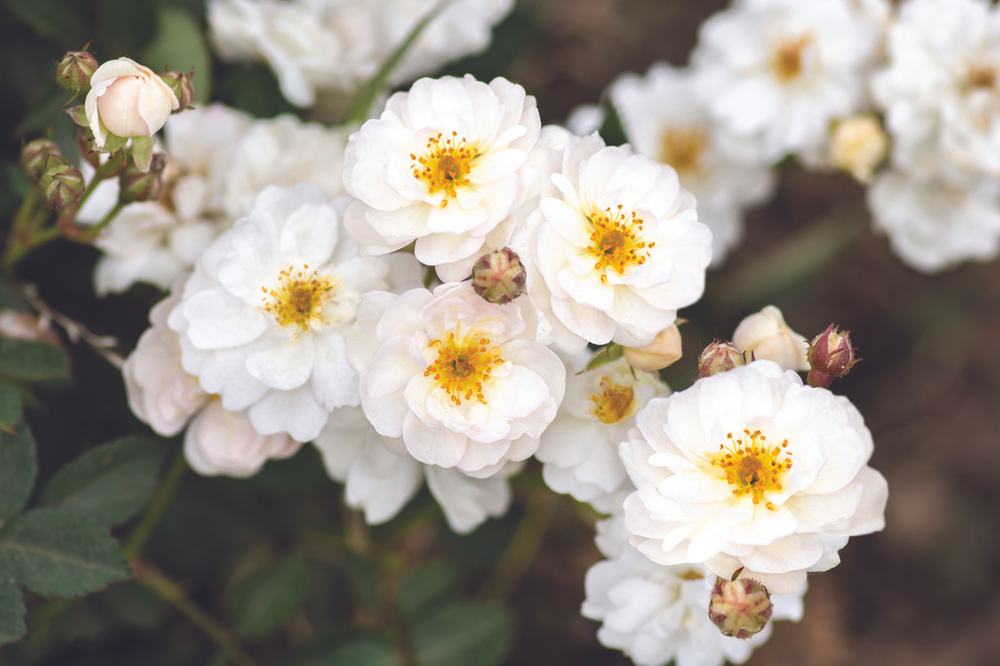
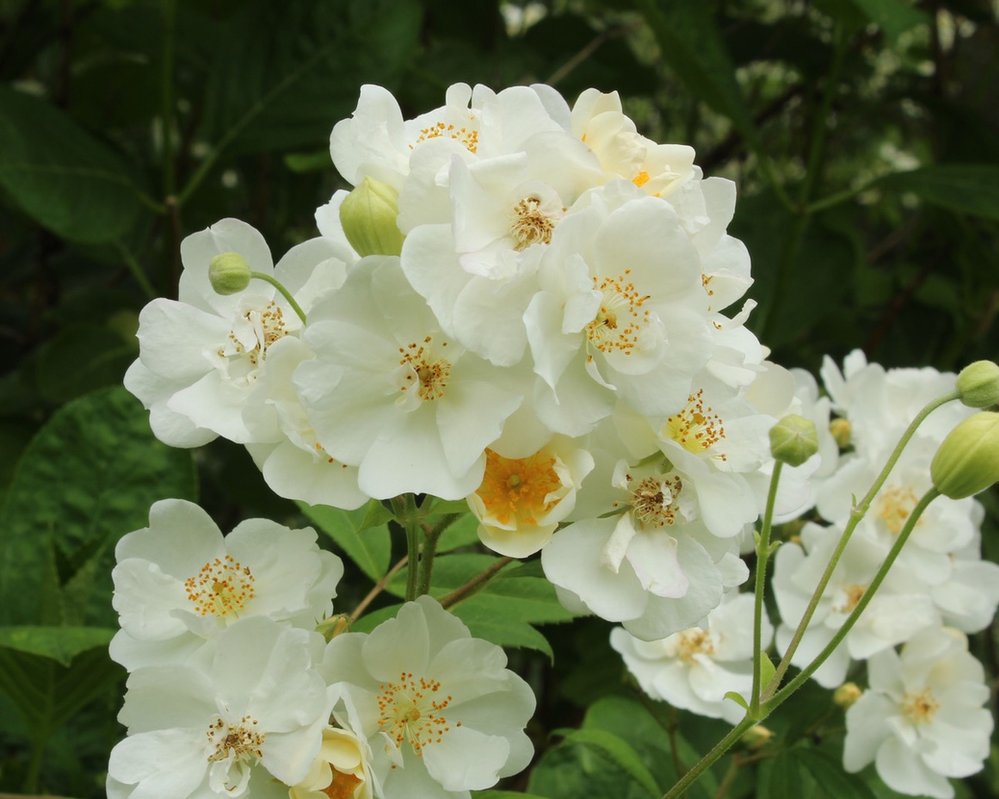
‘Seagull’ (1907, pictured ABOVE), the result of R. multiflora crossed with the Hybrid Perpetual ‘General Jacqueminot’, is apparently the sole rose bred by a Mr. Pritchard of the U.K. A very fragrant once-blooming rambler, it sends out arching canes with single and semi-double pure white flowers in large billowing clusters. Though able to decorate a small tree, it is not outrageously rampant. The sheer white blossoms and the smaller habit differentiate it from ‘Rambling Rector’. If you do not have space for a tall tree-robing rambler—like ‘Rambling Rector’, ‘Kiftsgate’, ‘Lykkefund’, or ‘Wedding Day’—this is the rambler for you.
Although ‘Seagull’ is pure white, not all gulls are. Gulls are primarily white as adults, greyish brown as immature birds. Some also show grey and/or black in their feathered raiment.
A few gulls, like Bonaparte’s Gull and Laughing Gull, wear a black hood. Most, however, are white-capped: Western Gull, Glaucous Winged Gull, Herring Gull, etc., but hybridization and backcrosses occur, much like today’s Hybrid Teas roses, especially among the white-headed types.
Gull-like fossils have been found dating back 24 to 37 million years. About 51 different gull species exist today. They are gregarious and colonial. Gulls adapt easily to environments altered by human beings, one of the few bird groups that do. Landfills often supplement their usual marine diet. Most larger gulls, like Bonaparte and Great Black-backed Gulls, will eat the eggs and even chicks of other species, especially of terns and plovers.
In the 1970s female pairing was observed among gulls in several areas of Southern California. This so-called “lesbian gulls” behavior resulted from estrogen effects of human DDT use in the environment. Many gulls, male and female, failed to develop courtship behavior, and male gulls abnormally developed ovarian tissue and ducts for the passage of eggs. Similar feminization effects occurred among other sea birds, marine mammals, and fish. To repeat, not all gulls are pure.
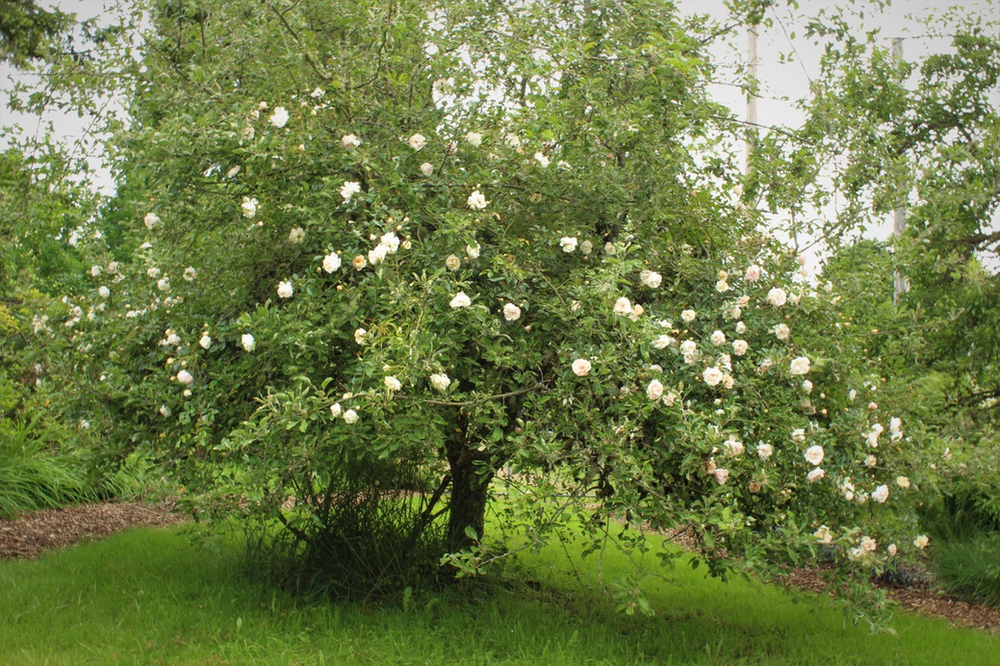
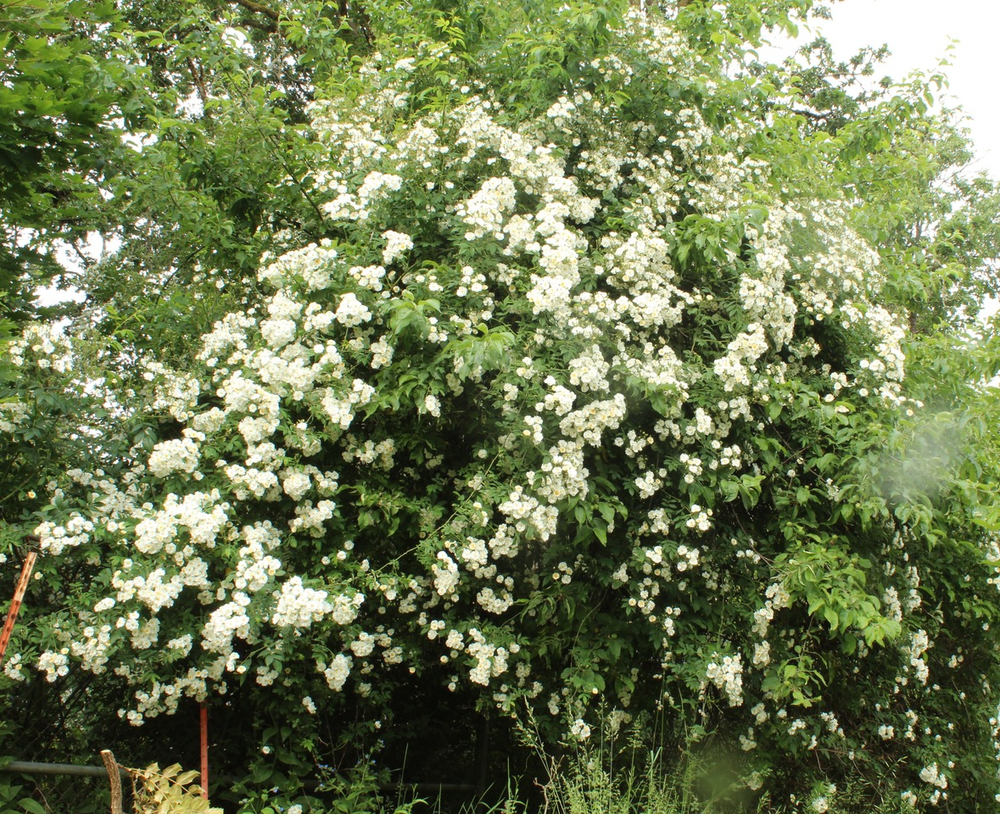
‘Rambling Rector’ (RIGHT) has already been mentioned. The breeder of this rose is unknown. It was found in 1910 (some say 1912) at the Daisy Hill Nursery in County Down, Ireland. But it was not—is not—a wild Irish rose. A tall plant, even (to keep it Irish) Brobdingnagian, with very far-reaching and quite prickly canes, it blooms once a year in an unforgettable mass of creamy white flowers, double and semi-double with amber stamens. Trusses of forty to fifty flowers surrender a strong, musky scent. It rambles religiously onto and over anything nearby. (After all, religo in Latin means a fastening or a binding to something, and religio, a bond between human beings and gods.) It looks best hanging from or embroidering trees. Dappled shade suits it fine. If you cannot have enough of it, or should you wish to overwhelm someone, friend or enemy, it is easy to propagate.
Discovered by Thomas Smith of Daisy Hill, it appears to be an older rose of the Multiflora family, renamed as a foundling. The name may have been given tongue-in-cheek
for any long-winded clergyman enamored of his own rambling homilies. Though not a species rose, I can hear in my head a barbershop quartet singing of it as “My wild Irish rose, sweetest flower that grows.” Certainly, it rambles wildly enough to seem akin to several wild roses.
Conclusion:Even as rambling roses were the floral signs of the times, so barbershop harmonies were the songs of the times. I confess, though it’s rarely a barbershop melody, I often find myself singing as I work among my roses.
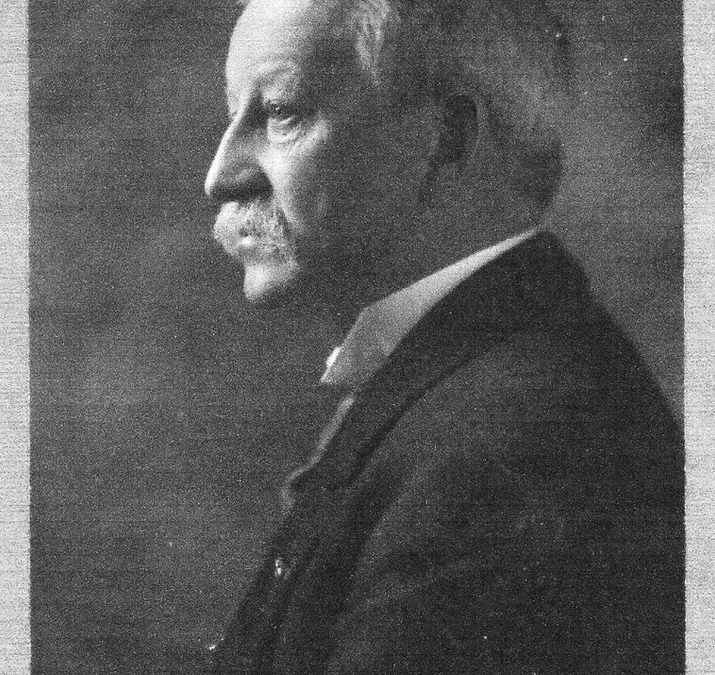
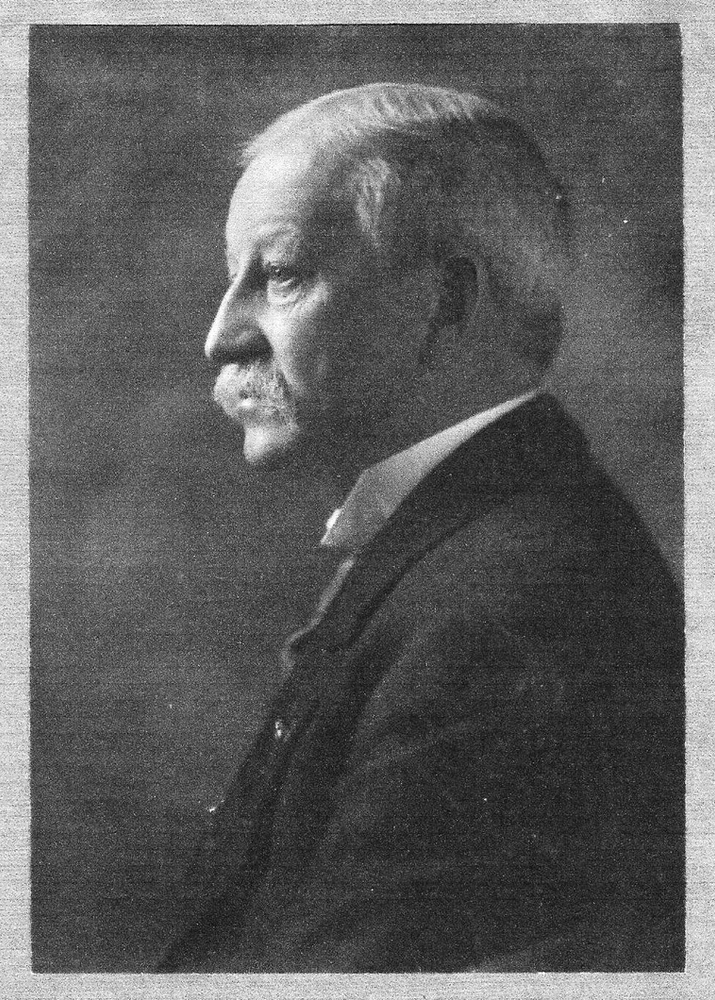
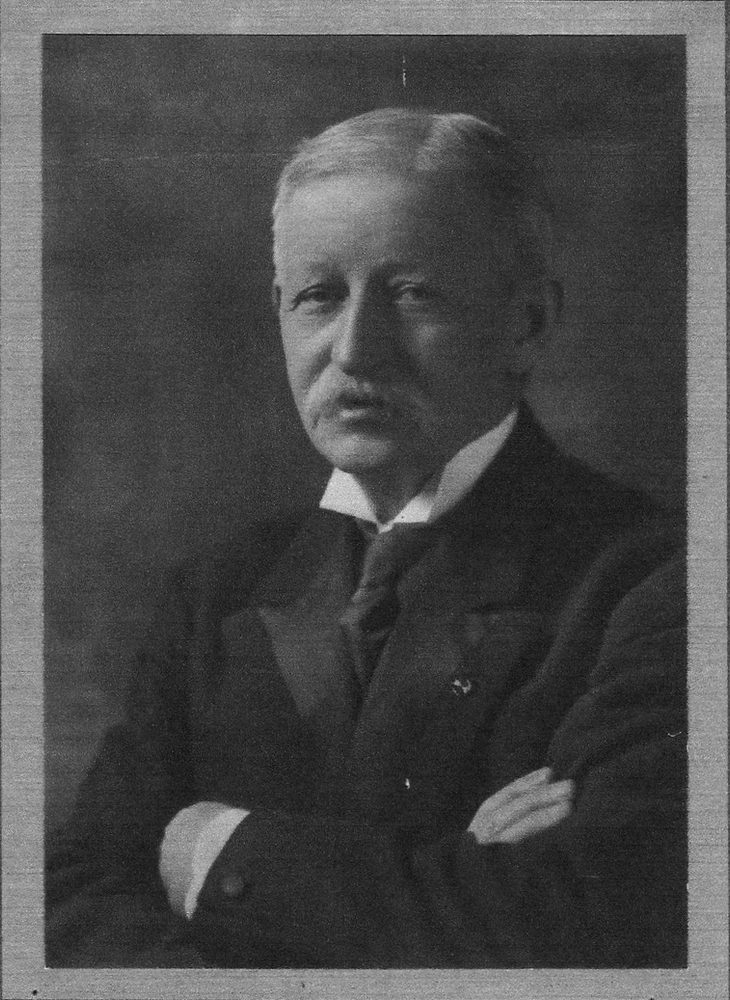
In August of 1854 eleven year old Robert Huey (January 15, 1843-March 12, 1928), along with parents Robert and Sophia Huey, emigrated from Ireland to Philadelphia, PA. In contrast to many fellow famine-devastated countrymen his family was financially stable. In 1858 he began his study of dentistry in nearby Lancaster, PA in the offices of Dr. John Waylan.
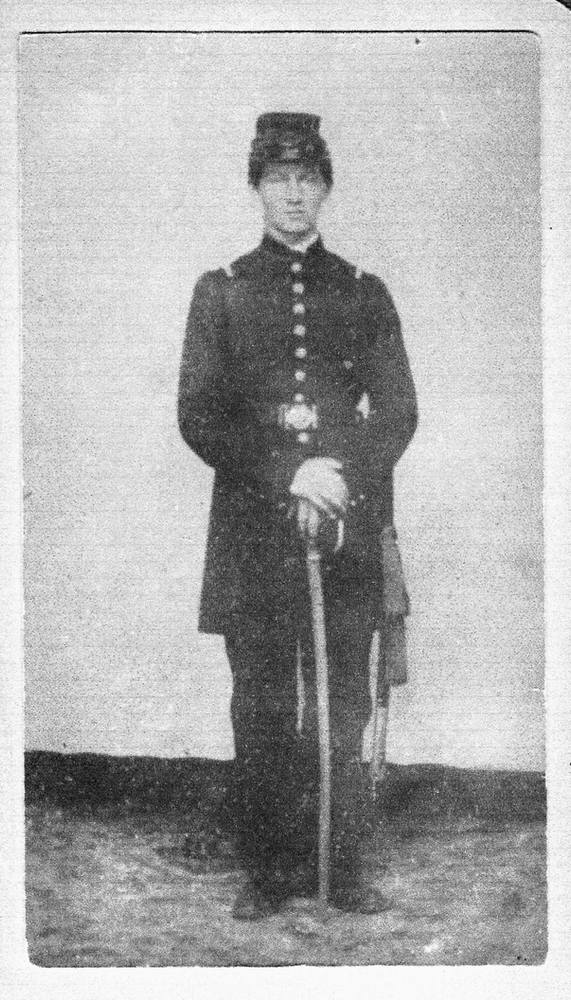
Just days after Confederate forces fired on federally occupied Fort Sumter in Charleston Harbor, young Huey responded to President Abraham Lincoln’s April 15, 1861 call for men to “maintain the Union.” He traveled to Camp Curtin in Harrisburg and enlisted in the 1st Pennsylvania Infantry, Company K, for a three month term of service. The regiment’s muster roll states that he was initially enrolled as a Musician, a practice that somewhat tacitly allowed regiments to accept boys and young men aged eighteen and under. Huey never actually became a member of the regimental band, but was assigned, rather, to commissary duty.
After being outfitted with muskets and cartridges, haversacks, and food provisions the regiment, under the command of Colonel Samuel Yohe, traveled south from Harrisburg by rail on April 20th. It was decided after arriving in Cockeysville, MD to return north to Camp Scott, near York, PA in order to refrain from provoking further unrest among the citizens of Maryland regarding the issue of secession.
After Union General Benjamin Butler occupied and declared martial law in Baltimore in the first weeks of May the 1st PA Infantry again traveled south to Maryland to guard the rail lines just outside the city of Baltimore. In the ensuing weeks the regiment was moved to various points to guard the roads and rail lines between Frederick and Baltimore. As part of a reorganization of Pennsylvania troops Huey’s regiment returned to Chambersburg, PA in early June. After assignment to General Patterson’s command the 1st PA Regiment returned to Maryland, guarding roads in the vicinity of Frederick. In early July the regiment was ordered west to Martinsburg to assume “garrison” duty. The First Battle of Bull Run or Manassas was just days away. On the very day of the first major battle of the Civil War, July 21, 1861, Robert Huey and the 1st PA received orders to move to Harper’s Ferry. Days later they boarded the train for Harrisburg, where they were mustered out July 27, 1861. It was said of the regiment that though it had not fought in any battles, “. . . its timely arrival in the field accomplished much good by checking any rash movement on the part of the Rebels in arms along our borders. The duties it was called on to perform were faithfully done, and its good conduct, under all circumstances, was appreciated and acknowledged by its superior officers.”
The men of Huey’s company returned to their homes in and around Lancaster. By mid-August, however, their captain, Henry A. Hambright, had sought and received authorization to raise a three-year regiment. In early September young Robert Huey, along with many members of the former company, joined the new unit, the 79th Pennsylvania Infantry.
By October 11, 1861 all the companies in the new regiment had reached full enrollment. They traveled to Harrisburg and then to Pittsburg, settling in Camp Wilkins under the command of Brig. General James S. Negley. During the unit’s stay in Pittsburg Huey was appointed the regiment’s Commissary-Sergeant. In late October they traveled by steamer down the Ohio River to Louisville, KY and from there, in December, to Munfordville, KY. Their duties so far primarily consisted of drilling and picket duty in the cold, rain, and mud of a southern winter.
On February 14, 1862 the 79th PA was ordered to reinforce General Ulysses S. Grant’s movement towards Forts Henry and Donelson in Tennessee, one that would eventually lead to the momentous battle at Shiloh. Fortunately for young Robert Huey, the order was soon countermanded and the regiment proceeded to Nashville, TN. During the ensuing months the unit traveled throughout Tennessee, guarding rail lines, repairing bridges destroyed by Confederate troops, and on occasion engaging enemy pickets.
Late in May General Negley’s brigade, then camped in Columbia, TN, was ordered east to assault Confederate forces entrenched in Chattanooga. After a victorious skirmish at Sweden’s Cove they reached the Tennessee capitol on June 6th and began shelling enemy troops. After two days of “brisk cannonading” Negley claimed victory and returned his command to Shelbyville, TN.
The 79th Pennsylvania would remain in Shelbyville for several months, celebrating the 4th of July there with parades and artillery salutes, enthusiastically encouraging pro-Union sentiment. Shortly thereafter they were sent southeast to Tullahoma where the regiment was reassigned to a new command under General William S. Smith. From there young Robert Huey and company were ordered back to Nashville to protect the region’s railroads and bridges.
In August plans were made for Union General Ambrose Burnside to advance into northeast Tennessee and drive Confederate forces out of Knoxville and the Cumberland Gap. Federal troops, including General James Shackelford’s newly organized 3rd Brigade (Cavalry), successfully occupied Knoxville on September 2nd. The brigade pursued retreating Confederate troops throughout the region with skirmishes occurring at Bull’s Gap, Carter’s Station, Zollicoffer, Blue Springs, and Blountville.
Their pursuit led them just above the Tennessee/Virginia border to Bristol.
Robert Huey’s skills as Commissary-Sergeant must have come to the attention of Colonel James P. T. Carter, commander of the 2nd East Tennessee Mounted Infantry (USA), one of the regiments assigned to Shackelford’s brigade. On September 13th, during the above mentioned campaign, Huey mustered out of the 79th PA and joined the staff of the 2nd TN as a lieutenant and Acting Assistant Adjutant-General of Commissary.
After the successful rout of Confederate troops at Bristol, the 2nd TN, the 7th Ohio Cavalry, and four guns from the 2nd Illinois Battery were detached from the 3rd Brigade on October 17th and sent to Rogersville, TN to establish an outpost intended to secure lines of communication. Lieutenant Huey records in his diary that after their arrival Colonel Carter was granted a thirty day leave of absence to visit his wife who was ill. Subsequently, Huey was ordered to “report for duty” to Colonel Israel Garrard, commander of the 7th OH.
Confederate forces led by General William “Grumble” Jones were alerted to the presence of the Union troops near Rogersville on November 3rd. According to an account written by the 7th Ohio’s Quarter-Master Sergeant, John L. Ransom, on the evening of November 5th, the “rebel citizens got up a dance at one of the public houses in the village and invited all the union [sic] officers.” Whether it was deliberate plot on the part of some of Rogersville’s southern sympathizers to distract Union leaders is unknown. The officer left in command of the 2nd TN was Major Daniel Carpenter. He reported being alerted to a Confederate movement in nearby Kingsport by Colonel Israel Garrard late in the day. The next morning Rebel troops began their attack. Sergeant Ransom stated that “Not one officer in five was present.” Confusion reigned. After several hours of fighting, Colonel Garrard and a significant percentage of the 7th OH “cut their way out.” Despite the efforts of Major Carpenter 608 of the 893 men of the 2nd TN were captured including young Lieutenant Robert Huey.
From Rogersville the prisoners were marched to Bristol, VA. From there they boarded boxcars and traveled by train to Richmond. Huey and twenty-two commissioned officers from his regiment were imprisoned in Libby Prison on November 12th; the enlisted men were taken to Belle Isle in Richmond’s James River. During the ensuing winter months the conditions were brutal. Lack of food, freezing temperatures, severe overcrowding, and infestations of lice made life miserable for the officers who were at least quartered inside a brick building. Although tents and blankets were provided for a percentage of the enlisted men imprisoned on Belle Isle, a greater number were forced to survive with no shelter whatsoever.
Increasing Union military pressure on the Confederate capitol prompted the Confederate government to consider moving Richmond’s prison population further south. In mid-January of 1864 construction began on a stockade near a small rail depot in Sumter County, Georgia. Named Fort Sumter by Confederate authorities, the horrors that would occur in what would become known as Andersonville give voice to the capabilities of human animosity.
Two events occurring in February further augmented the urgency to transfer Union prisoners out of Richmond. On the 9th 159 men (not including Huey) escaped from Libby through a sixty foot tunnel. Although many were recaptured a sense of alarm gripped the city. In response, the first trainload of prisoners from Belle Isle was sent to still-under-construction Fort Sumter. Several days later Union General Judson Kilpatrick, aided by Colonel Ulric Dahlgren, led a failed raid on Richmond. Its civilian population, unnerved and panic-stricken, demanded further action. By late March Belle Isle was emptied, the living having been transported from one hell to another. Remaining in Richmond, however, were over 1000 Union officers.
By late April Confederate authorities faced a dilemma at Andersonville. Although intended to be a prison for enlisted and political prisoners 110 officers arrived among a large group of POW’s (captured near Plymouth, NC) on the 30th. Commander of the Georgia Reserves, General Howell Cobb, reminded the commander of the prison Captain Henry Wirz that a facility named Camp Oglethorpe in nearby Macon, GA had served as a stockade two years earlier. The next day the officers were transported the sixty plus miles north to Macon. Confederate Inspector General Samuel Cooper made it official on May 2nd instructing Cobb to “Make proper provisions for the safe keeping of Federal officers to be sent from Andersonville to Macon, Georgia.”
The door was now open to also remove the remaining Union prisoners from Richmond. On May 7th the commissioned officers housed in Libby Prison, including Lieutenant Robert Huey, were loaded on trains and sent southward. After pausing at the stockade in Danville, VA the train continued southward to Macon.
On the morning of the 17th twenty-four carloads of wretched-looking men arrived at Camp Oglethorpe. A two-week veteran of the camp, Chaplain Henry White of the 5th Rhode Island Heavy Artillery, was shocked by their appearance. He wrote, “A new class of suffering was before me. The men were old [long-term] prisoners, and pale and haggard. They were ragged, and some partly naked. They were filthy, and covered with vermin.”
Twenty-one year old Robert Huey lived there among a group that would eventually number roughly 1400 on a plot of ground about the size of two and a half football fields. The higher ranking officers slept inside the one enclosed building still standing from the stockade’s former days as a fairground. A few dozen men slept under the building, some in roofed wooden structures without floors or walls; many slept under the stars. Cooking pots and utensils were limited and shared by all. Three small barrel-sized wells provided drinking water for everyone inside the stockade walls. Food consisted primarily of maggot-infested bacon and un-sifted corn flour, although some vegetables could be purchased by those that had the means to barter.
As in many other Civil War era prisons the men fought despair and tedium in numerous ways at Camp Oglethorpe. Sunday preaching and mid-week prayer meetings led by captured Union minister-soldiers sustained many. One prisoner noted the formation of a literary society made possible by the purchase of a library of books and magazines from a Macon citizen desperate to raise some cash. Card games, baseball games, classes in foreign languages, and evening social gatherings occupied some. Tunneling, as a means of escape, was another dedicated enterprise. In his “Reminiscences” Huey noted that he enthusiastically joined in the effort, digging every other night for three weeks. On the 4th of July the prisoners celebrated with patriotic speeches and rousing patriotic songs.
Let no one think that these pursuits made life easy for the men imprisoned at Camp Oglethorpe. Scurvy and debilitating dysentery ravaged hundreds and killed some. A prisoner from Wisconsin wrote, “To fall ill was vile, to stay well a miracle.” Those unfortunate to have been wounded prior to arriving in the central Georgia stockade received little in the way of medical care. Almost all were afflicted with infestations of lice. The seeming lack of concern for their condition as prisoners on the part of the Federal government, the rarity of news from family members, exposure to the extremes of weather, lack of food, and the emotional baggage of being a prisoner in a hostile environment was devastating. A lieutenant from my home town of Mechanicsburg, PA made a note in his diary, “Tired, weary of nothing to do. The continual wandering of the mind into vague reverie, until it becomes a burden to itself, is wearisome in the extreme.”
General William Sherman’s successful advance on Atlanta prompted Confederate leaders to contemplate moving the prisoners out of Macon in late July. On July 27th, just as one of Sherman’s cavalry leaders, General George Stoneman, began his southerly raid to free his captured Union comrades, the first of two groups of roughly 600 men were loaded on trains headed to Charleston, SC. Approximately twenty-four hours later the second group departed. Lieutenant Huey was among the first 600 to leave Macon. After arriving in Charleston they were confined in the city jail yard until an outbreak of yellow fever forced many, including young Huey, to be relocated to the nearby U.S. Marine hospital.
On October 5th the severity of the yellow fever outbreak and the controversial use of human shields by both sides in the ongoing bombardment of Charleston led to the transfer of Federal prisoners to Camp Sorghum in Columbia, SC. After dark on the 6th Lieutenant Huey and Lieutenant James C. McDonald (also of the 2nd TN), jumped from their train transport just north of Orangeburg, SC and made their escape. They traveled through swamp and dense woods frequently relying of the good will of slaves to provide food and direction. After several days they decided to “take the main stock road through Newberry and Greenville to North Carolina.”
After arriving in the vicinity of Laurens, SC Huey and McDonald inadvertently revealed their presence to a local via the smoke of a campfire. A pack of dogs was raised and the pair was chased down, recaptured, and temporarily confined in the Laurens Court House on October 18th. Shortly thereafter, they were sent back to Camp Sorghum.
In the SC stockade it was routine for sentries to allow small groups of prisoners to step outside the guard line to collect firewood. In just over two weeks Huey recognized an opportunity to once again escape. Late in the afternoon of November 4th he “noticed that the officer of the guard was very careless with paroled squads, in fact that he was a little “loose,’ or “tight” as some people call it . . . He allowed the paroled prisoners to pass the lines without counting them.” Lieutenant Huey, unable to find his previous accomplice McDonald, grabbed another messmate, Lieutenant J. C. Martin (1st East Tennessee Artillery), and calmly joined a squad headed out to collect firewood. As they hid themselves in the woods several other prisoners joined them.
During the ensuing weeks Huey and company made their way through the South Carolina countryside. The threat of being recaptured kept them cautious about revealing their presence or when in need of directions. Once again the benevolent assistance of the slave population played a significant role in their journey.
By the 22nd of November the band reached the Chattooga River, the dividing line between northwest South Carolina and northeast Georgia. After successfully passing themselves off to locals as Confederate soldiers on furlough they were ferried across the river and continued their journey. After crossing into North Carolina Huey and company began to encounter Union sympathizers who kindly provided food and shelter and pointed them toward other “loyal” families along their way. Huey recorded, “We are getting so robust and hearty with the abundance of nourishing food that we think nothing of the exertion of our marches; during the first days after our escape every mile was an exertion, but now, our only trouble is our feet. I am the worst off in this particular being practically barefoot and limp along with difficulty; if only I had a good pair of shoes.”
Their travels took them almost due west across the Little Tennessee and Nantahala Rivers toward the head waters of the Hiawassee River. Union sympathizing NC soldiers, home on furlough, provided guidance across the mountainous terrain; several asked to accompany Huey in his attempt to reach Federal lines.
On December 4th they crossed into Tennessee near the Ducktown copper mines and headed toward the home of retired Union General James Gamble on the banks of the Ocoee River. From there the company traveled northwest to Charleston, TN, the nearest Union outpost, arriving on the 6th. By his estimate, Huey and his fellow prison escapees had traveled 387 miles more or less barefoot and in the same clothes worn when captured thirteen months earlier.
Because of their haggard appearance the group was immediately arrested and detained, suspected as Rebel spies. When questioned by the officer in charge Huey requested permission to communicate with Union General Samuel P. Carter headquartered in nearby Knoxville in order to confirm his identity. Within an hour Carter joyously replied and provided train transport to Knoxville for Huey and his companions – three Union officers and five civilians. The small company took the first train to Knoxville where they were celebrated as heroes. Lieutenant Huey was made an aid to General Carter and his fellow escapees were granted leaves of absence. In his new position Huey signed certificates of loyalty for his North Carolina friends and found them employment.
Robert Huey ends his reminiscences with a sobering post script likely added some years later. “Of the four hundred ninety-four Officers and enlisted men of the 2nd East Tenn. Mounted Infantry regiment captured at Rogersville, Tenn. Three hundred and eighty-two died from disease and starvation in Rebel prisons. Had I not escaped there would probably have been three hundred and eighty-three.”
A return to civilian life began for Robert Huey when he was honorably mustered out on January 14, 1865, one day before his twenty-second birthday. He returned to the study of dentistry, graduating from the Pennsylvania College of Dental Surgery in March of 1867. Dr. Robert Huey married Katharine [Catherine] C. Goepp on December 28, 1874; the couple had five children, two boys and three daughters (Robert Jr., Alice Katharine, Helen, Clifford Carr, and Katharine). His family life was tragically marred by the death of his wife in 1885, his youngest son in 1887, and his oldest son in 1896.
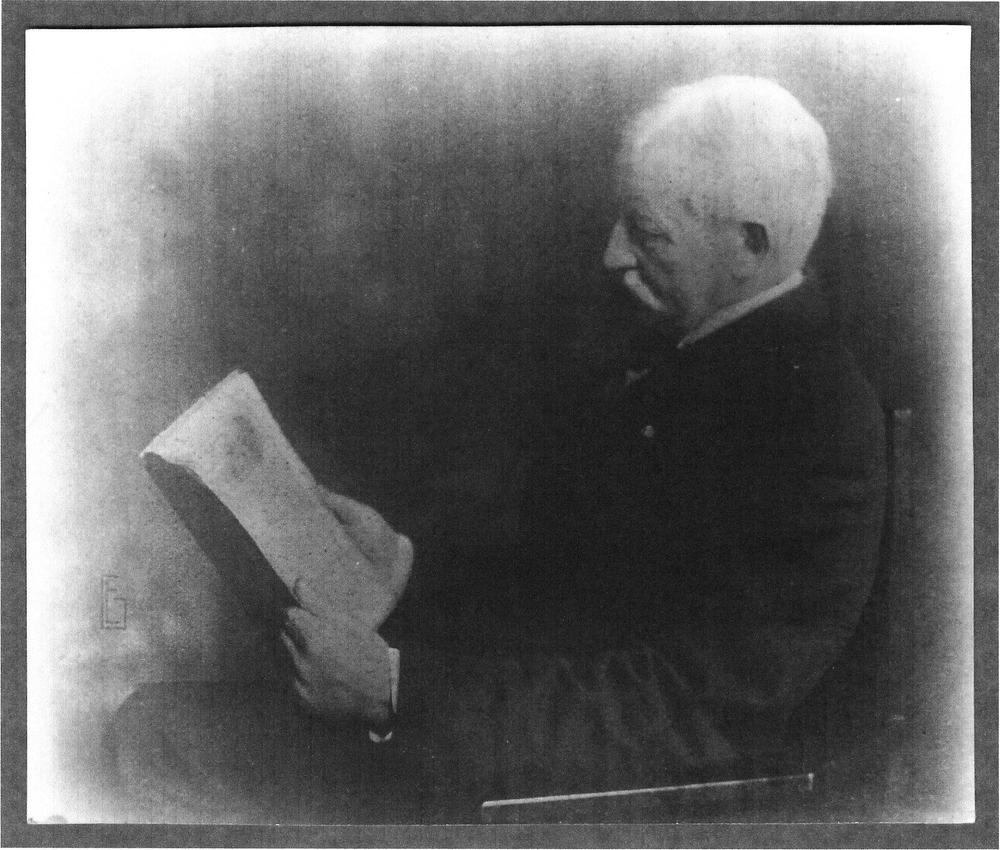
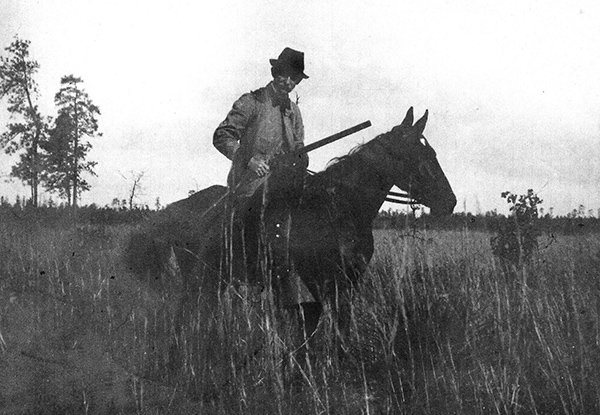
Perhaps because of these tragedies Dr. Robert Huey filled his life with numerous activities and affiliations. He was well-known as a pioneer and lecturer in the field of dental surgery while a member of the faculty at the newly formed School of Dental Medicine at the University of Pennsylvania. He served in various positions with the Pennsylvania Board of Dental Examiners and the Pennsylvania Association of Dental Surgeons. Outside his vocation Dr. Huey served as president of the English Setter Club of America and was involved in promoting and participating in dog shows and field days. He grew fond of another outdoor activity as well, one he pursued with characteristic Huey enthusiasm – growing roses.
A record of Huey’s interest in roses appears in correspondence shared with J. Horace McFarland, editor of the American Rose Annual.
“My earliest rose recollection is of an attempt to pluck a moss rose in my grandmother’s garden and of getting my fingers pricked by the sharp thorns. Rescued by the nurse, the thorns were removed, and I was turned loose in the belief that a lesson had been taught. Nevertheless, I wanted that rose, and returned to the attack with a like result. Mother then appeared on the scene, took in the situation, cut the rose, removed the thorns, and made me happy with the flower. I have loved roses ever since.” n
[Editor’s Note: from the mention of a nurse it may be reasonably postulated that the incident occurred before Huey’s immigration to America at age eleven. His heritage as a son of Ireland explains his future patronage of the Irish rose-growing firm Alexander Dickson & Sons.]
Editor McFarland further quoted Huey:
. . . After being established in [dental] practice upon my return [from the war], and feeling the need for outdoor relaxation, I purchased a home and two acres of ground in 1877, and began to try to grow roses. There was then little reliable information to be had, and the flowers that resulted compared most unfavorably with illustrations in the catalogues, while the plants would die by the dozen. Persevering, I finally met with success, and knowing that many others were thirsting for knowledge I began writing and talking of my experiences and how my difficulties were overcome, thus doing a sort of rose missionary work.
Among those “converted” by Huey’s missionary efforts was a young banker from a prominent Philadelphia family, George C. Thomas, Jr. Between the two substantial contributions to successful outdoor rose culture were made with unique emphasis placed on the advantages of grafted/budded roses and on the suitability/adaptability of specific rose cultivars and classes for the diverse climatic conditions found across the United States.
The initial work was begun by Huey the mentor. In 1896 the June edition of The American Florist reported a lecture given by the doctor to the Pennsylvania Horticultural Society entitled “Outdoor Roses,” drawing special attention to his “experience with a great variety of roses.” Leonard Barron noted in his book Roses and How to Grow Them that Dr. Huey had by that time [1905] thoroughly tested every Hybrid Perpetual in the Dickson & Sons catalog. He also invested noteworthy effort in evaluating the relatively new group of roses classified as Hybrid Teas. Due to his close association with Alexander B. Scott, American agent for A. Dickson & Sons, Huey was one of the first American rose enthusiasts to grow the newly introduced ‘Killarney.’ In an article appearing in the March, 1905 issue of the periodical Country Life in America, Huey noted that he had observed a decided advantage in budded plants of ‘Ulrich Brunner’ when compared to a bed of “strong own-root” plants of the same variety. In a grand moment of irony, he advised, “It is very probable that the best stock for our use has not yet been introduced . . .” Although Rosa multiflora became the rootstock of choice for many growers another choice would unknowingly be created by Huey’s most ambitious understudy.
After being gifted with fifty rose bushes from Dr. Huey in 1901 George C. Thomas, Jr. set about breeding roses in 1912 with a goal of producing everblooming climbing roses and better garden varieties. His first introductions were hybridized at the family’s Bloomfield Farm. In 1914 a dark red once-blooming seedling resulted from a cross of ‘Ethel,’ a light pink Hybrid Wichuraiana, and the scarlet ‘Gruss an Teplitz,’ a vigorous Hybrid Tea. It and several other seedlings were sent to the Rutherford, New Jersey nursery firm Bobbink & Atkins for evaluation where their commercial introduction was delayed for several years by the commencement of the First World War.
Meanwhile Robert Huey’s influence as an American authority on growing roses continued to broaden. He was well-known by many of the movers and shakers associated with the ARS, including Robert Pyle, president of the Conard-Jones Company. The 1916 edition of Pyle’s How to Grow Roses contains a section dedicated to Huey’s recommended varieties for “Philadelphia and Vicinity.”
That same year Dr. Huey was present at the annual meeting of the officers of the American Rose Society in Philadelphia. ARS President S. S. Pennock recognized him as “one of the best amateur rose-growers in this country” and invited him to address the group. Huey praised the society for the publication of its first Rose Annual (1916) and proposed that the ARS direct its focus more toward the general public rather than commercial growers. He further recommended the creation of a committee that could provide information and answer questions regarding rose culture (the eventual formation of that committee would lead to the creation of the Consulting Rosarian Program).
Additionally, during the meeting President Pennock read a letter written by George C. Thomas, Jr. suggesting that a system of point-scoring be adopted to more accurately assess the “outdoor” merit of new rose introductions. Originated by Thomas, Dr. Huey, and Portland, Oregon rosarian Jesse A. Currey the system was to be implemented in the new wave of test-gardens being created throughout the United States [Of interest to the author is the creation of a standard definition for single-flowered roses – “A single rose shall be one which has from four to ten petals . . .”].
Huey’s interest in the pros and cons of budded plants prompted him to write an article entitled “Propagation by Budding,” published in the 1917 American Rose Annual. Forty years of growing roses had convinced him that buddedrose bushes, in particular Hybrid Perpetuals, Teas, and Hybrid Teas, were superior to own-root roses in growth and development. In addition to ‘Manetti,’ and seedling Brier (R. canina), he specifically recommended Rosa multiflora for roses grown in the Philadelphia region and gave detailed, illustrated instructions on “how-to.”
At the spring 1917 annual meeting of the ARS a resolution was passed to increase the size of the executive committee. Along with the Rev. E. M. Mills, J. Horace McFarland, W. G. McKendrick, and Dr. Huey were elected as Honorary Vice-Presidents of the American Rose Society, “the object being to elect representatives from amateur membership, who, by their interest, would tend to increase the membership of the Society.
Shortly after this meeting America joined its allies France, Great Britain, and Russia (April 6, 1917) and declared war on Germany. George C. Thomas, Jr., an amateur aviator, volunteered to join the war effort. After a period of training and outfitting, his squadron left for Europe where he would fly a number of bombing missions.
In January of 1918 Dr. Huey was appointed to fill a vacancy in the Rose Test-Garden Committee, filling a void created by the death of Admiral Aaron Ward. Later that year Dr. Robert Huey’s garden was requisitioned as part of a land grab associated with the expansion of Philadelphia’s Hog Island shipyard – part of America’s massive endeavor to put more naval vessels into the war effort. The ongoing work of Captain George C. Thomas, Jr. would become the megaphone giving voice to the accumulated experience and knowledge of the now elderly doctor.
Early in 1919, now “Captain” Thomas returned to his home in Philadelphia. On June 4th of that year he and his wife entertained the executive committee of the American Rose Society in their Bloomfield garden. During the meeting Thomas dedicated seedling number 720, the aforementioned dark red hybrid to his mentor Dr. Robert Huey. He recorded some personal comments about the rose in the 1920 edition of his book, The Practical Book of Outdoor Rose Growing, “It has been our good fortune to breed a crimson maroon climber which Dr. Robert Huey has chosen from among our seedlings to bear his name. The rose is a very dark color and blooms most profusely during its season. It is semi-double and retains its petals and color for a long period, besides being of vigorous growth.” Although the rose, named ‘Dr. Huey,’ did not meet Thomas’ repeat-flowering breeding goal, he believed it possessed enough individuality to merit introduction
Huey, despite the loss of his garden, continued his rose missionary work locally – preaching the gospel of good growing practices. At a meeting of Philadelphia’s New Century Club in December of 1922 Huey delivered a lecture that has been recorded for posterity. Entitled “The Cultivation of Out-Door Roses,” seventy-nine year old Dr. Huey outlined a regimen of practical strategies that could pass for the latest in how-to: a situation with plenty of circulation, away from invasive tree roots, staggered planting, well-drained, loosened, weed-free soil, regular fertilization, mulch, appropriate pruning based on knowledge of the growing habits of the cultivar, protection from winter frosts, removal of diseased foliage, thorough irrigation, and CHOOSING SUITABLE CULTIVARS!
Dr. Huey had been a member of the Pennsylvania Horticultural Society since 1905, serving as Vice-President from 1917-1918. In recognition of his pioneering work with roses he was honored with the society’s Gold Medal in November of 1924.
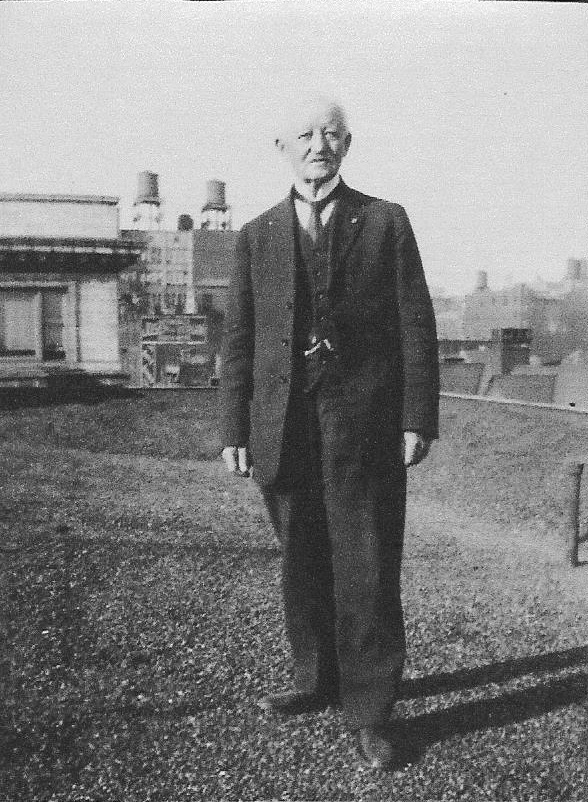
The last years of soldier, dentist, dog-lover, and venerated rosarian, Dr. Robert Huey, were lived in relative peace and quiet. He lived on Spruce Street with his unmarried sister-in-law Eleanor Goepp. On March 12, 1928 Dr. Robert Huey died at his home of heart failure at eighty-five years of age. He was buried in nearby West Laurel Hill Cemetery beside his wife and sons. An obituary appearing in The Dental Cosmos read,
“As a practitioner of dentistry the service of Dr. Huey both to his clientele and to his profession was the reflex of his character as a man: conscientious, sympathetic, a lover of humanity, he gave of the best that was in him, gave it cheerfully and abundantly. His loyalty to any cause that enlisted his cooperation was unflinching and enthusiastic. His war record, his cooperation in dental society work, his helpfulness in the many social and special activities that engaged his interest, testify to the conscientious thoroughness which characterized all his undertakings.
It is said with much truth that “all the world loves a lover” and the underlying thought has a general as well as a special application. Dr. Huey was a lover in the larger meaning of that term. He loved his friends and in that category may be fairly included not only his human relationships but all living things “both great and small” that came within the wide circle of his life interests. It was that quality, the sincere and sympathetic regard in which he held all who won a place in his friendship that endeared him to them. His friendship was a benediction and a benefaction that will endure throughout the lives who knew him.”
by Suzanne Horn, Master Rosarian, Pacific Rose Society
This article was first published in the Pacific Rose in January 2020 and is a 2020 Award of Merit winner
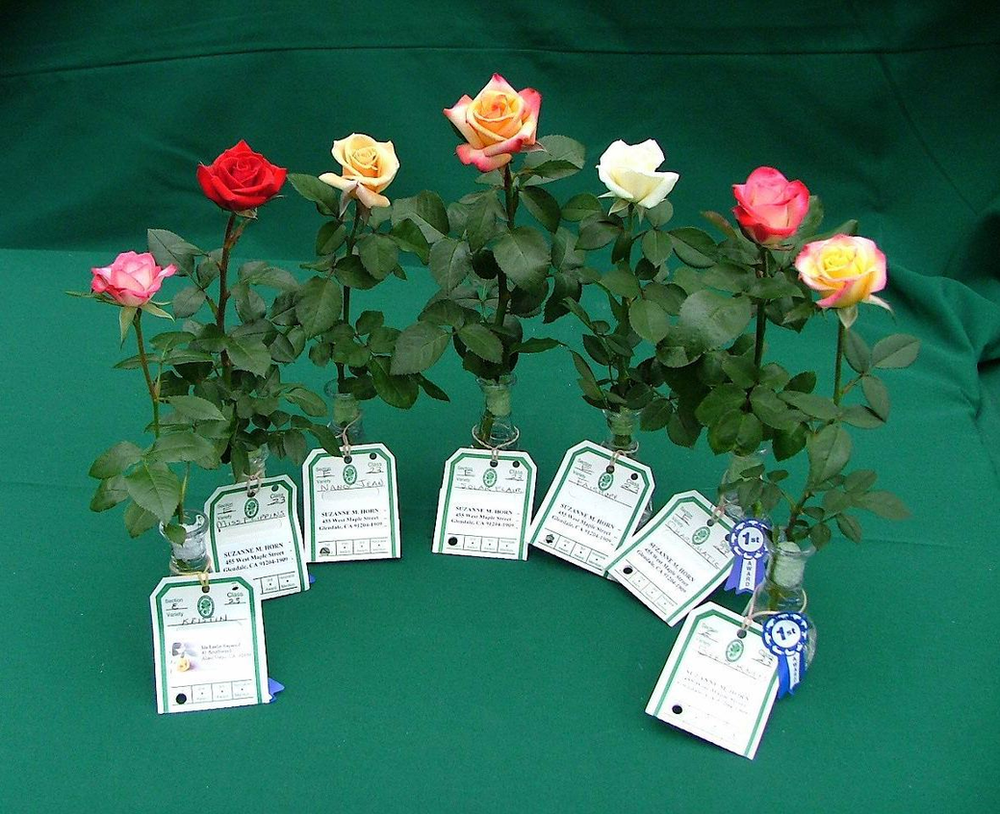
Solar Flair Queen shown by Suzanne Horn at OCRS Show, photo by Leslie Espagnol
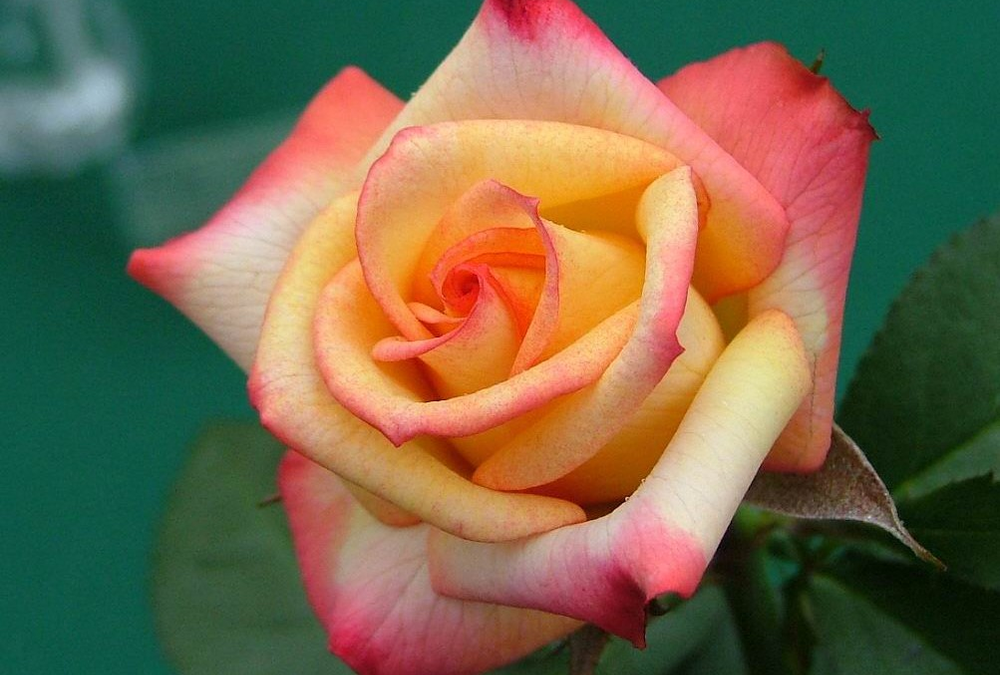
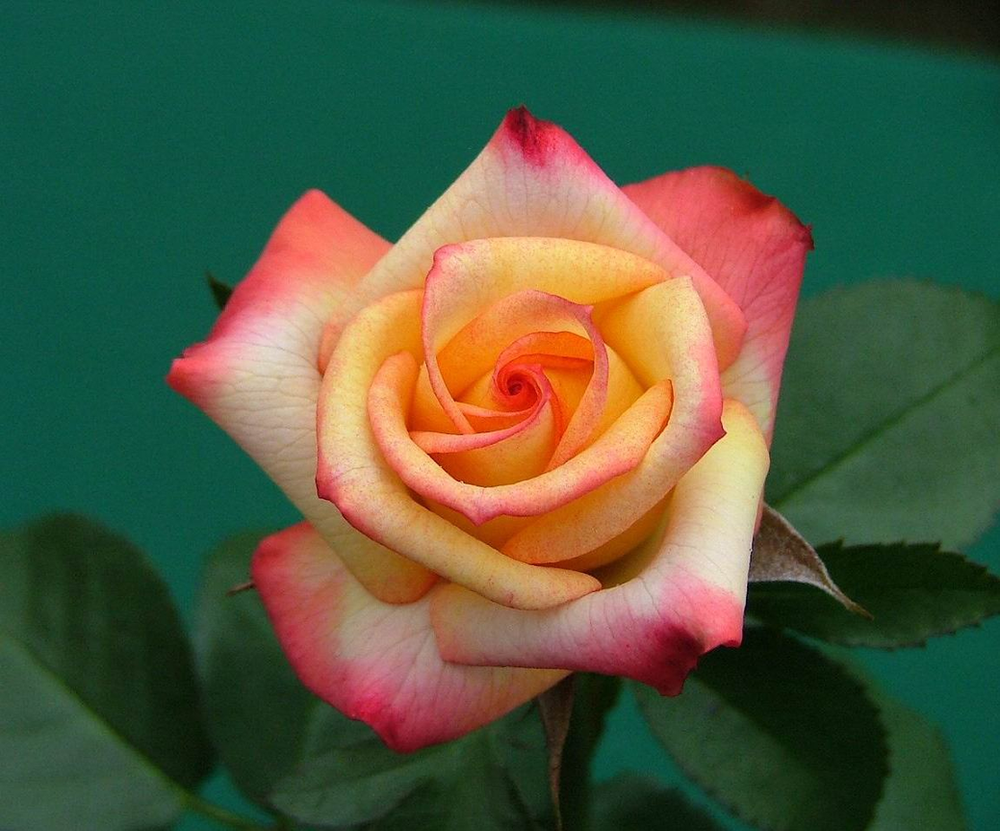
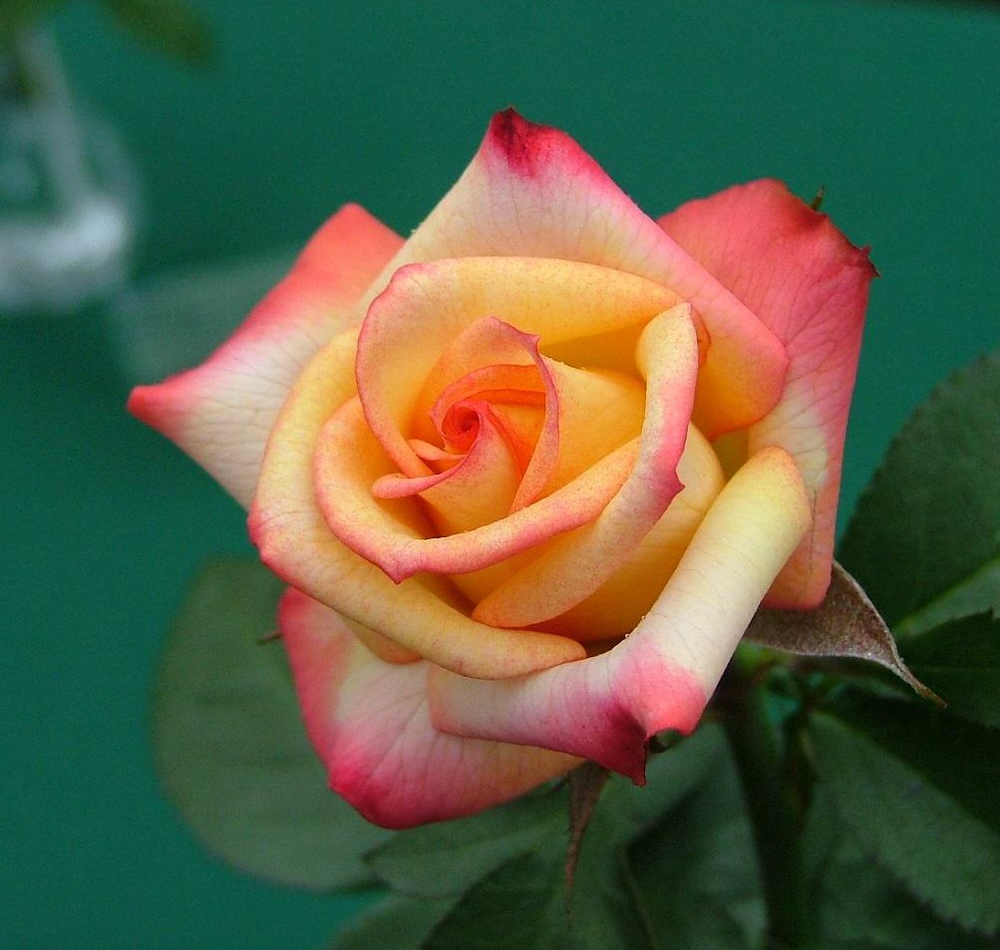
My featured rose this month is an exceptional miniflora rose, ‘Solar Flair’, which is also one of my favorite roses in commerce. It is a hot, bi-color rose created by the late great hybridizer and exhibitor, Frank Benardella, and it serves as a fitting tribute to the hybridizing talents of this great rosarian. ‘Solar Flair’ was bred by Mr. Benardella in 2004, and was released in 2005 by a company called Nor’East Miniature Roses aka Greenheart Farms, which has since ceased to sell roses to the public.
This luscious miniflora (code name BENbaas) is a cross of Antique Gold x Brett’s Rose. It is a colorful yellow blend (yb) that has some of the best and most consistent form I’ve ever seen. For the exhibitors among us, this exciting miniflora has become a top show rose and is definitely a queen contender. It has already made its mark on trophy tables all over the country. In fact, ‘Solar Flair’ has been one of my favorite roses since I won the first Queen in the nation with it back in October of 2005.
The first bloom of ‘Solar Flair’ I ever entered in a show won Queen with a unanimous polling of the judges on the first round. I immediately went out and ordered ten more. See photos of my Miniature Queen of Show at the Orange County Rose Society Show along with the Miniature Royalty. All the roses were mine except the little one on the left (grin). Incidentally, the reason the rose won Miniature Queen and not Miniflora Queen was because at the time classes for miniflora roses had not yet been established. Therefore, rose shows combined miniatures and minifloras under the same category. It was largely due to the sheer excellence of the roses produced by Frank Benardella that the miniflora rose became as successful as it is today. The following is a little background on the magic man who brought the rose world so many fabulous introductions.
Born on July 5, 1932, Frank was a native of Millstone Township, New Jersey, where he lived with his lovely wife June. He was a robust man with a kind demeanor and a soft-spoken manner. He was known to be friendly to all he met, and he reminded me for all the world of the actor Christopher Walken. He was a Senior Vice President of International Sales for the Goody/Rubbermaid corporation, traveling around the world. Fun fact: Rubbermaid is a company which co-incidentally makes the brand of cool box that many rose exhibitors (including me) use to transport their miniature roses to shows. LEFT Frank & June Benardella, photo courtesy of Roseshow.com
Frank developed an interest in roses in the 1950’s when, along with his wife June, he built a rose garden for her widowed mother. He subsequently built his first rose garden and after two years of growing roses, joined the American Rose Society. Frank then began growing and exhibiting roses; and it was a love affair that would last a lifetime. He garnered a wealth of knowledge about growing roses, and he willing passed on his wisdom to others. RIGHT: Solar Fair Queen shown by Suzanne Horn at OCRS Show, photo by Leslie Espagnol
As an exhibitor, Frank won most of the prestigious National Trophies. The trophy of which he was most proud was the Nicholson Bowl, a class that calls for nine matched hybrid tea roses. At that time his main interest was in regular sized roses. It wasn’t until years later that he became interested in miniatures. Exhibiting for Frank was a family affair, and he traveled to the major shows with June and the kids.
He quickly became an ARS judge and subsequently assisted in the writing of the ARS Judges Manual. He also became a Consulting Rosarian and won the Outstanding Consulting Rosarian Award in 1964. He joined his local Penn-Jersey District Rose Society and was elected District Director shortly thereafter. While he was District Director, Penn-Jersey hosted a special event celebrating 100 years of Sam McCredy’s Roses, attracting visitors from all over the world. Frank originated the first Mid-Winter Conventions during that period. These first conventions were held outside of rose show season. However, a fun fact I learned from the great U.K. rose exhibitor Ray Martin is that Frank encouraged enough members to grow roses under artificial lighting in their basement that they managed to stage rose shows at the conventions.
Frank was soon made Penn-Jersey Regional Director and subsequently President of the American Rose Society, a position in which he served from 1977 through 1979. He also became Vice President of the World Federation of Rose Societies, all the while remaining active in his home rose group, the Jersey Shore Rose Society. A little-known fact is that for years beginning in 1999, he pushed and encouraged Bob Martin to run for Vice President of the American Rose Society. That ultimately worked out very well, since Bob is our current President and has turned out to be exceptional in the position. In every way, even in his encouragement of others, Frank was a great champion of the rose.
I learned much about Frank’s background from Ray Martin. He advised that while Frank served as ARS President, “… amongst his many achievements he is credited with helping to develop the Palette class, instigating the ARS slide contest, developing the English box and printing the first miniature entry tags.” These are only some of the reasons that Martin documents Frank Benardella as Number One on his list of “rose heroes”.
Although he was a very successful exhibitor, Frank was unhappy with the selection of varieties available to him at the time. This sparked his interest in hybridizing. He initially focused on hybrid teas but was not impressed with the results of his crosses. A yellow Ralph Moore rose called ‘Rise ’n Shine’ became the starting point for his future successes.
ABOVE: Solar Flair Queen amid royalty at OCRS Show, all but one rose shown by Suzanne Horn, photo by Leslie Espagnol
Frank’s first introduction hit the market in 1985, and Ray Martin shared an interesting story about how it almost didn’t. He wrote, “The rose was growing in Frank’s greenhouse when Sean McCann, a regular visitor to the Benardella household, spotted it and insisted that Frank should introduce it. The variety, Black Jade, is still probably the most popular miniature rose in its color class today.”
In 1993, Frank introduced what was to prove to be his favorite miniature rose, a seedling known as BENmagic. When his initial suggested name of Pure Wet was turned down by the ARS as being unsuitable, he named the rose after his newly born granddaughter, ‘Kristin’. In addition to becoming a wonderful exhibition miniature rose, ‘Kristin’ became an exceptional pollen parent. It was an aphorism of the day that the flowers of ‘Kristin’ held so well that they appeared to turn to potpourri on the bush.
In 1994, Frank retired from his job at Rubbermaid in order to pursue his avocation of hybridizing roses. By that time, he had a number of roses from his breeding program in commerce. He continued to travel the world with June to rose growing hubs like Holland, Germany, Switzerland and South Africa. He gained acclaim for his hybridizing efforts in such areas as Japan, South Africa, Europe and New Zealand. RIGHT: Frank Benardella in Greenhouse, photographer unknown
Although Frank Benardella is mostly associated with miniature and miniflora roses, in 1995, he introduced a hybrid tea rose that was so commercially successful in the florist rose trade that it literally put him at the forefront of his hybridizing hobby. I learned from Ray Martin that “many of Frank’s roses are bred from crosses with his own seedlings and many of these seedlings owe their existence to crosses that Frank made with a collection of florist roses that he imported from Kordes in Germany.” To that end, Frank crossed the floribunda ‘Picasso’ with one of his own unnamed seedlings; and the resulting plant was a striped red blend hybrid tea he called ‘Zebra’.
Ray continues, “This was officially the first ‘bred’ striped HT. There are other striped HTs but they are sports. The floristry trade saw this new rose and loved it! Zebra was set to be Frank’s most successful rose. Over 1 million blooms were sold in the first year and royalties on the rose meant that the Benardella family would now move to Englishtown, New Jersey and Frank would be able to build for himself a state-of-the-art breeding house and more roses would soon be coming off the production line.”
Benardella became one of America’s most successful independent rose breeders, specializing in miniature and ultimately also miniflora roses that were as perfectly shaped as the classic hybrid tea rose, but on a smaller scale. These were roses that appealed to people with limited gardening space. Many of his roses would be tested in a variety of venues in a variety of countries before being introduced. He noted that the process of hybridizing roses is painstaking and often lengthy, with five to seven years, on average, between the first hand-pollinization or “cross” between parent roses and introduction of a marketable new rose.
A big part of the work of hybridizing is culling the less-promising seedlings. Frank noted in a matter-of-fact manner, “Ninety-nine percent of it is garbage.” Seedlings with two few petals, a lack of substance or a propensity for various rose diseases would be discarded.
In a story entitled “Earning His Stripes as a Hybridizer” in the 1994 American Rose Annual, exhibitor extraordinaire Frank Mattia wrote, “Benardella’s approach to creating Miniature roses involved making at least 50 crosses with the pollen from a parent plant, using a Hybrid Tea with excellent bloom form into a proven Miniature seed parent that readily sets hips. The crosses are made in the greenhouse over a four-month period between April and July. The Kordes cut flower ‘Laguna’, an orange-red Hybrid Tea, is one of his favorite pollen plants, since it readily passes on its desirable traits of good form and a panorama of pleasing bloom colors.”
Mattia continued, “Benardella, drawing on his background as an exhibitor, has achieved his hybridizing fame by consistently creating Miniature roses with classic Hybrid Tea form. It is the prime characteristic of nearly all his commercial successes. Indeed, the success of Benardella’s roses abroad revolves around the demand for picture-perfect Miniature roses for the cut flower trade.”
Frank was once quoted as saying, “I breed mostly for form. I want the flower to look pretty.” He certainly succeeded with that aim. In his later years, Frank was working on hybridizing a brown rose, something with hues of cocoa and coffee. When asked why, he answered, “Because it’s a challenge. Because it’s not there, at least not a brown rose without a lot of orange.”
Surprisingly to many, Frank was not initially a big fan of miniflora roses, although thankfully his attitude on the subject did evolve over time. He originally felt that minifloras were too big to be competitive at rose shows against the popular miniature roses. In discussions I had with Frank in years past, he advised me that he routinely discarded beautiful seedlings that he deemed too large to be introduced as miniature roses. It was not until the advent and subsequent popularity of the miniflora class that he began introducing some of those earlier seedlings that had not been discarded. The rose world is forever grateful that he did so.
Frank has been described as being “an icon in the World of Roses”. He certainly was to the international rose exhibiting community and to the countless number of rose lovers who grew his spectacular roses. In the years before he died, Frank was especially concerned about the future of roses based on recent trends and the “aging out” of dedicated rose growers. In recent years, rose sales have declined sharply and membership in the American Rose Society has also plunged to half its former size. While in the past national rose shows attracted 1,000 entries, Benardella noted, “now you’re lucky to get 300.”
Frank was once quoted as saying, “People don’t garden the way they once did, and now all you see going in the ground are those shrub roses sold as low-maintenance plants. To have beautiful roses, you do have to work at it a little. They need care, they need grooming. They need you.”
On a side note, hope springs eternal for the future of the American Rose Society, as it is now led by self-proclaimed rose evangelist Bob Martin. His knowledgeable and enthusiastic leadership is inspiring more interest and participation in rose societies, rose shows and exhibiting than ever before. In addition, there is the exuberance and dedication of Chris VanCleave from Alabama, the self-proclaimed “Redneck Rosarian” and head of Membership for the ARS, who is also spreading the love of roses nationwide. LEFT: Solar Flair MF Court, shown by Suzanne Horn at Desert Rose Society Show, photo by Suzanne Horn
We lost Frank Benardella to cancer on January 30, 2010 at the age of 77. However, he has left behind a magnificent body of work for the rose lovers of the world to remember him by. His legacy includes having had a number of roses admitted into the Miniature and Miniflora Rose Hall of Fame including ‘Black Jade’, admitted in 2006, and ‘Kristin’, elected in 2011. This honor is reserved for roses that have proven their worth over time and remained in commerce for more than 20 years.
At least 18 of his miniature and miniflora introductions received the coveted AOE (Award of Excellence) accolade. For those readers not familiar with this program, in 1973 the American Rose Society Board of Directors established the Award of Excellence to recognize new miniature and miniflora rose varieties of superior quality and marked distinction. Award of Excellence winners are chosen only after a two-year trial in nine public test gardens nationwide. The trials gauge how well roses do in a variety of American climates.
Frank noted, “You need to get them out there. I grow roses in the greenhouse and they look like one thing. Outside, they can look like something else.” Outside, the seedlings could prove to be meager bloomers or susceptible to diseases like powdery mildew or blackspot.
Benardella’s Miniature AOE award winners included the medium pink ‘Baby Boomer’ (2003), the dark red ‘Black Jade’ (1985), the red blend ‘Bonfire’ (2006), the dark red ‘Caliente’ (2005), the light pink ‘Figurine’ (1991), the pink blend ‘Jennifer (1985), the red blend ‘Jim Dandy’ (1989), the red blend ‘Kristin’ (1992), the red blend ‘Magic Show’ (2009), the red blend ‘Merlot’ (2001), the medium red ‘Old Glory’ (1988), the red blend ‘Picotee’ (2003), the dark red ‘Ruby’.
His Miniflora AOE winners included the apricot ‘Ambiance’ (2008), the mauve ‘Deja Bleu’ (2008), the white ‘Leading Lady’ (2006), the medium red ‘Power Point’ (2008), and the apricot ‘Show Stopper’ (2007). Additional outstanding miniature roses he introduced included the recently released dark yellow ‘Bob Martin’ (2018), the red blend ‘Hilde’ (1999), the medium pink ‘Jilly Jewel’ (2003), the orange-red climbing miniature ‘Radiant’ (1988), the pink blend ‘Rosie’ (1987), and the pink blend ‘Soroptimist International’ (1995). Additional exceptional miniflora roses he introduced included the red blend ‘Double Take’ (2008), the medium pink ‘Flawless’ (2008), the pink blend ‘Focal Point’ (2008), the red blend ‘Liberty Bell’ (2003), and our featured yellow blend rose in this article, ‘Solar Flair’ (2004).
Although Frank specialized in hybridizing miniature and miniflora roses, he did dabble in creating larger roses like the red blend floribunda ‘Pinnacle’, the red blend hybrid tea ‘Zebra’ and the white climbing hybrid tea ‘Pele’. Kitty Belendez later discovered an orange sport on ‘Pinnacle’, which she named ‘Cristina Lynne’.
I may have missed a few of Frank’s stellar creations on my list, since he was so prolific in his hybridizing. Frank himself eventually lost track of exactly how many new roses he introduced worldwide, but no fewer than 35 are available in U.S. markets. And more keep coming. Some good news is that many of his seedlings that were not introduced during his lifetime are now being named and introduced by Richard Anthony at ‘For Love of Roses’. In addition, amateur hybridizer Suni Bolar inherited a greenhouse full of Frank’s seedlings from June Benardella at the time of Frank’s passing; and she has utilized those seedlings into her own breeding program. As such, we will be blessed to be able to enjoy more of Frank’s work being introduced to the public in the future.
As for ‘Solar Flair’, this gorgeous miniflora rose literally speaks excellence to you. The blooms are absolutely stunning, presenting exquisite exhibition form, complete with high centered, hybrid tea shaped blooms. Beautiful, pointed ovoid buds unfurl to reveal perfectly spiraled blooms with pinpoint centers set upon long straight stems. Those impeccably formed blossoms come mostly as one bloom per stem, although the occasional spray will present itself. The petals are quilled and are reminiscent of Glowing Amber and Amber Star, which are full of substance year-round.
Its most notable feature is, of course, its eye-catching, almost electric hue, a dazzling golden yellow with bright red edging. It will stop you in your tracks in the garden with its stunning color blend, and it will be the one to draw your focus across a showroom filled with hundreds of other roses. Furthermore, the medium green, semi-glossy foliage sets a complimentary frame for the stunning red-gold blooms.
As far as growth habit goes, the plant is quite robust, and the blooms are full-figured, measuring up to two inches or more across when fully open and presenting 27 to 35 petals. It is medium tall, growing from 24 inches to about 36 inches, and grows in an upright manner, which makes it excellent for growing in containers.
This spectacular miniflora is not totally disease resistant, but it is not a mildew magnet either. It does its best here in the Pacific Southwest if it is sprayed on a regular basis. A good and diligent spray program along with occasional morning showers to the foliage will keep it looking clean and beautiful throughout the year.
To summarize, ‘Solar Flair’ continues to be one of the best miniflora roses I’ve had the privilege to grow, a showstopper both in the garden and on the trophy table. It is currently available from For Love of Roses (www.forloveofroses.com) as part of their collection of miniature and miniflora miniature offerings for sale. Along with so many of his other magnificent introductions, ‘Solar Flair’ carries on the legacy of the late, great Frank Benardella. Through his roses and the memories of those of us who knew him, he will never be forgotten.
by Nanette Londeree, Master Rosarian, Marin Rose Society
This is a 2006 AOM winner, Originally published in The Marin Rose in 2006
Herb Swim grew up on a small farm in north central Oklahoma where his family grew mostly fruit. In his book, Roses – from Dreams to Reality, he says, “The first roses in my memory were in the front yard of my parent’s home on a farm……the only ones I can clearly remember are the red and the yellow ones.” His love affair and lifelong interest in roses germinated there, and he would go on to create some of the world’s most popular roses.
At age thirteen his family moved to town, and he saw little of either fruit trees or roses for a good many years. High school was followed by college where he had trouble deciding what to study. He enrolled in the School of Agriculture at what is now Oklahoma State University and found the curriculum generally tedious except for the fascinating course on plant genetics. He was the only student to receive an A+ in the class. Next, he had to decide on a major and chose pomology – the study of pome fruits, where he learned that the “pome fruits” included not only apples, pears, and the stone fruits but also strawberries, blackberries, and Rosaceae – the rose family. After graduating from college in 1928, he took a job as a trainee under a golf course architect that brought him west to southern California. After a short stint at another golf course, he got a job at the Coolidge Rare Plant Gardens where he spent the next three years focused on roses. He then joined Armstrong Nurseries, started by John Armstrong in 1889. The business specialized in fruit trees and roses. Where Coolidge Gardens had grown a few thousand rose plants, Armstrong grew hundreds of thousands and had customers, both wholesale and retail, all over the globe. He was thrilled with the opportunity to work on breeding both fruit trees and roses, and began work under Dr. Walter Lammerts, the Director of Research at Armstrong.
Around this time, the plant patent act was approved by Congress, and it provided a new incentive to breeders. They could now recoup the cost of developing plants, so the hybridizing efforts at Armstrong increased. With his knowledge of genetics, Swim was a big help to Lammerts. One of the first notable roses that Lammerts developed was the stunning deep pink hybrid tea ‘Charlotte Armstrong’, a rose that would go on to be parent to many award-winning offspring. Swim succeeded Lammerts when he left in 1940, and eager to create something on his own, using ‘Charlotte Armstrong’ as a parent, he released ‘Princess Angeline’ in 1945. That was followed by four All America Rose Selections (AARS) winning roses – two in 1947, ‘Pinkie’ and ‘Nocturne’ and two in 1949, ‘Forty-niner’ and ‘Tallyho’. His next big success came with the introduction of the super fragrant yellow hybrid tea ‘Sutter’s Gold’ in 1950, another AARS winner, followed by ‘Helen Traubel’ in 1951, ‘Mojave’ in 1954 and ‘Circus’ in 1956.
After fifteen years as Research Director at Armstrong’s, Swim found himself more involved in administrative matters than in the plant breeding which he so loved. At the age of forty-eight, he left to form a partnership with Ollie Weeks, owner of Weeks’ Wholesale Rose Growers. They were the first to use greenhouses for both their hybridizing and growing of new seedlings – a novel approach that would ultimately be adopted by the major hybridizers. In 1956 they had their first real disaster – the lot of new seedlings had been inadvertently stored at freezing temperatures; only 2,000 of the 50,000 seedlings from that year’s breeding survived. The next year these same plants, now planted in the field, were exposed to extraordinary Santa Ana winds – and completely buried in sand. A few years later, Swim would take note of one of these seedlings in their trial garden – a hybrid tea growing nearly 10 feet tall and covered with more than fifty, long stemmed, dark red, super fragrant blooms.
During this time, Swim received more AARS awards for roses developed while he was at Armstrong and released after he had moved on. ‘Garden Party’, ‘Duet’, ‘Summer Sunshine’ and ‘Royal Highness’ were all big hits, as well as some he’d developed with David Armstrong – ‘Eiffel Tower’, ‘Joseph’s Coat’, the brilliantly colored climbing rose, ‘Sweet Afton’ and ‘Lemon Spice’.
From the lot of seedlings that had been through freezing and sandstorms came two splendid roses – that awesome 10-foot hybrid tea would be christened ‘Mr. Lincoln’ and the other ‘Oklahoma’. Both of these dark red, super fragrant beauties were crosses of ‘Chrysler Imperial’ and ‘Charles Mallerin’. Swim & Weeks won their first AARS awards in 1964 for ‘Mr. Lincoln’ and ‘Camelot’. Having great success with very fragrant roses, in 1968 Swim introduced another powerfully perfumed rose in ‘Angel Face’, a lovely mauve floribunda and in 1973, ‘Perfume Delight’, a brilliant pink hybrid tea.
An accumulation of health problems made Herb consider retirement in 1967. With agreement from Weeks, their partnership was dissolved, and Swim went back to work on a part time basis for Armstrong to help train new research staff. Swim found Arnold Ellis who was hired by Armstrong to fill the Research Directors position and also hired an assistant for Ellis, Jack Christensen. From this point, Swim collaborated in the development of roses with both Ellis and Christensen. Perhaps one of the most renowned of Swim’s roses, with Ellis, was the introduction of the extraordinary rose, ‘Double Delight’, (ABOVE: Photo by Rich Baer) the result of a cross of ‘Granada’ and ‘Garden Party’. This rose has an intense fragrance on a bloom that ranges from creamy white to strawberry red depending on sunlight – every bloom is different. He and Christensen introduced the winning ‘White Lightnin’ and the gorgeous apricot hybrid tea ‘Brandy’ (ABOVE RIGHT).
In addition to twenty-five AARS winners, four of his creations have been awarded the American Rose Society James Alexander Gamble Fragrance Medal – ‘Sutter’s Gold, ‘Double Delight’, ‘Angel Face’ (ABOVE) and ‘Mr. Lincoln’. ‘Double Delight’ is also a winner of the World Rose Hall of Fame in 1985. Swim says in his book, “Looking back on a career spanning almost forty-four years spent mostly with roses, it seems that I experienced not just the fulfillment of a dream, but of dream after dream.” How fortunate for us rose lover’s that we’re able to plant and enjoy his dreams! ABOVE: Sutter’s Gold.
by Carolyn Elgar, Master Rosarian, Orange County Rose Society
This is a 2020 AOM winner
Ann Boleyn, courtesy David Austin
Most experienced rosarians know about the impacts of pH on nutrient availability in the soil. But what about the quality of your irrigation water? It has its own pH; plants can be negatively affected when its pH is extreme, 4.0 and below or 10.0 and above. Acceptable levels for plants of pH in irrigation water are between 5.5 and 7.5. Roses do best in soils at levels of 6.0 to 6.5, a slightly acidic soil. What impact does high pH of your water have on your soil pH levels?
For roses in the ground, there are many mitigating factors that temper the pH level of water, and there is more space for the water to dissipate and spread. But potted plants grow in confined soil where the buffering protection is limited. Everything that goes into the pot will have a more intensified effect on your plants as space in the pot is limited.
Water alkalinity
However, the alkalinity of your irrigation water is even more important to consider than its pH. Alkalinity in this case does not refer to pH levels; rather it is determined by the amounts of calcium, magnesium, or sodium bicarbonate in the water. These amounts will affect the overall pH, but their excess is what changes your potted plants soil. Here alkalinity is a concentration of several ions, such as calcium, magnesium, or sodium bicarbonate.
The effect of soil that is highly alkaline on rose plants in pots is similar to the effect of high alkaline soils in your garden. Important nutrients such as iron, manganese, and zinc become unavailable. Plant growth may be stunted, and leaf tips turn yellow and burn because of the high salt contents. Overall chlorosis (yellowing) may occur; manganese is important in chlorophyll production, the process that keeps leaves green.
The environment where your water originates is one of the biggest influences on its alkalinity. Mountainous areas and rocky soils are high in mineral content. Water draining from these areas absorbs these minerals and enters treatment plants at high alkaline levels, especially where there is little rainfall. Rain leaches minerals from the soil and tends to have an acidifying effect, resulting in water with less alkalinity. But in arid areas, minerals build up in the soil; the water that passes through these soils will pick up minerals, increasing alkaline levels.
Water analysis
In a water sample, all the ions that make up its alkalinity are combined and reported as calcium carbonate, CaCO3, the main component of lime. The ideal range for total alkalinity is 30-100 mg/L, but levels up to 150 mg/L are acceptable. High alkalinity (over 150 mg/L) can result in high pH in water; high alkalinity and high pH can cause problems with nutrient deficiencies or imbalances. In addition, high levels of these salts can result in soil impaction, water absorption, and plant health.
How can you determine the alkalinity of your irrigation water? Most water districts publish an annual report that details the components of your water. Some of these components are legally regulated by Maximum Containment Levels, such as fluoride and aluminum. Minerals such as calcium, potassium, and sodium are not regulated, but their quantities are usually included, along with a measure of water hardness, which is determined by the amounts of CaCO3 in parts per million. Akalinity is measured the same way.
In this sample, the District of Southern California water district reports alkalinity ranges from 69-74 parts per million, while hardness ranges from 124- 130 parts per million. Levels of pH are at 8.4 to 8.5. The water from this district could be considered to be hard and high in alkalinity as well as pH levels.
In contrast, the Trabuco Canyon Water District shows a pH of 6.9, alkalinity levels of 144 parts per million, and hardness of 200 parts per million. Here is an example of a lower pH level despite the higher alkaline amounts. The Trabuco Canyon Water district is located at the foot of the Santa Ana mountains, where the soil is full of the rocks eroded from the mountainsides. This results in hard water, water that will leave mineral deposits in pipes and on fixtures.
A research paper from University of Massachusetts Amherst, published in October of this year, details the upper and lower limits of irrigation alkalinity in container soils.
Container Minimum alkalinity Maximum alkalinity parts per million CaCO3 parts per million CaCO3
Seedlings or plugs 37.5 65
Small pots/shallow flats 37.5 85
4-5 inch pots/shallow flats 37.5 105
6 inch pots/long term crops 37.5 130
Using these standards, one can see that the Trabuco Canyon alkalinity levels of 144 ppm indicates water with a high amount of minerals. Potting soil with a large amount of peat would be helpful here.
Looking at the chart above, it is obvious that alkalinity in water will have particular impact on seedlings or plugs of baby plants. Distilled water may be a better choice for them.
While there’s not much you can do to change the chemical makeup of your water, you can help alleviate its impact. Potting soils high in peat content will offer some buffer; peat is acidic in nature. Fertilizers acidify soil, but nitrates leach out and leave minerals behind. Flushing pots completely with water every three to six months will dissolve minerals and also diminish salts in the potting medium. Using a solution of 1/2 to 2 tablespoons of vinegar in one gallon of water will raise acid levels in the soil. The type of vinegar is important; apple cider and white vinegar seldom exceed five to ten percent strength and are less likely to damage plants. Flushing solutions such as Clearex can be used to drench the pot until there is 20-40% runoff from the bottom of the pot.
Determining alkalinity levels of the water you use is hard to do without a water report. A hand held pH meter may show high pH levels when you test your pot with it, but alkalinity can occur at lower pH measurements. However, if the soil has a high pH level, you can be certain it is not too acid. Based on your knowledge of your water contents and the high pH reading, trying some measures to reduce salts and alkalinity in your potted roses won’t make your soil too acid.
by Gaye Hammond, Master Rosarian, Houston Rose Society
This article is an AOM winner
Root deformation and heat saturation of planting media are common challenges associated with growing roses and other plants in a container – whether you are a commercial producer or a rose grower. A strong root mass means a strong plant and a strong plant is more resistant to insects, disease, weather fluctuations and is easier to care for overall.
Advances in technologies are helping address and overcome these challenges. Researchers at the University of Florence (Italy) have studied the effect of container design on long term plant health and their findings are very interesting. Plants grown for a long period in smooth-sided plastic pots result in deformed root systems. This happens because lateral roots are prevented from the normal horizontal growth pattern, contact the sides of the container, turn and begin to circle the root ball or the roots grow vertically to the bottom of the container and then begin to circle.
Some refer to this as the plant being “root bound” or “girdled.” Kurt Reiger at High Caliper Growing explains, “In plastic, roots circle the outside of the soil mass and leave a blank space in the middle. We are root specialists. Plants perform much better when they have a fuller, more complete and defined root structure. This is especially important for plants from which cuttings will be taken (like roses).” Circling roots that form at the bottom of the container usually fail to change direction and grow into the soil profile when transplanted. Eventually reduced root growth and continued root deformation impacts the overall vigor of the plant.
Mechanical intervention by making cuts on the root ball periphery or splitting and splaying the bottom third of the root mass are two common strategies for dealing with “root bound” plants. However, both strategies can cause transplant shock of already stressed plants. Correcting a malformed root system is critical to the long term health of a rose, especially hybridizers working with new seedlings.
The evolution of container designs intended to reduce deformation run the gamut of options from disrupting smooth container walls by inserting ridges; coating the inside of the container with a root-growth inhibitor; injecting root-inhibiting chemicals directly into the plastic before the container is formed and/or using woven plastic strands formed to shape that, in effect, cause roots to be air-pruned once they emerge into open air.
By testing panoply of container designs, scientists found that traditional smooth-sided containers produced and highest percentage of deformed roots when compared to plants grown in containers with air-pruning or mechanical impediments.
A solution to these challenges literally dropped into my arms at the Texas Nursery & Landscape Association Exposition several years ago. That year, I saved a display of Smart Pots™ (High Caliper Growing, Oklahoma City, Oklahoma) from tipping over and for coming to the product’s rescue went home with a Smart Pot™. The company representative suggested I walk through the trade floor and take note of how many of the fully grown trees at the Expo had been planted in these patented fabric pots. I was impressed.
Research has been done by Dr. Michael Arnold and Dr. Garry McDonald at Texas A&M University on the use of Smart Pots™ to reduce root deformation of container-grown Knock Out® Roses. According to Dr. Arnold, “Root deformation in the form of deflected roots at the container wall is an inherent problem associated with limited root volume of a container that leads to circling or kinked roots that may persist when plants are transplanted to either larger containers or in the landscape.” Dr. Arnold found that the use of Smart Pots™ decreased root deformation and circling of container-grown rose roots by five times and also doubled the size of the root mass compared to traditional plastic containers.
In a Smart Pot™, when a root tip reaches the side of the fabric container, it stops in place and initiates lateral or side-branching. As the process repeats itself, the entire area of the container is filled with fibrous root growth, allowing more surface area for mineral and water absorption.
Root architecture problems are not the only limitation when it comes to container-grown plants. Increased temperatures in the root zones, due to reflected radiant heat from gravel, concrete or other surfaces, together with container design materials can also negatively affect plant roots. According to the University of Illinois, dark colored, metal and black plastic containers develop the highest root zone temperatures.
Drs. Arnold and McDonald also found that the root balls of plants in Smart Pots™ were noticeably cooler and moister to the touch compared to those in black plastic containers, suggesting that evaporative cooling may be the cause of the reduced temperatures. With an outside ambient atmospheric temperature of a whopping 106° F roses grown in black plastic pots had a substrate temperature of 130.8° F, while plants in Smart Pots™ had substrate temperatures more than 33° cooler (97.4° F).
by Carolyn Elgar, Master Rosarian, Orange County Rose Society
This is a 2020 AOM winner
One constant problem that rose lovers have to deal with when cultivating their favorite flower is that of fungal disease. Powdery mildew, black spot, anthracnose and other leaf spot diseases, and rust are all fungal diseases that have spores that travel easily through the air to spread to other parts of the plant they inhabit or plants nearby. The parts of the fungus that produce the spores are not visible, so these diseases are not obvious until they have germinated and created spores.
Because of this, these diseases have to be addressed before we can actually see them. We do this by using fungicides, sprays that will kill the disease or prevent the spores from spreading. There are many different products available for this, and most of them work all of the previously mentioned diseases. Botrytis and downy mildew have different growth processes and are not usually affected by these fungicides.
Fungicide development history
The first efforts to deal with these plant diseases occurred in the 1600’s when farmers were concerned about the health of their food crops. Initially they used common products such as brine or arsenic; by 1760 the application of copper sulfate was used in seed treatment. In the mid 1800’s sulfur dust, lime sulfur, and finally the Bordeaux solution (a combination of copper sulfate and slaked lime) were used to deal with powdery mildew and other foliar diseases.
In the 1940’s as gardening and landscape plant production gained importance, a synthetically produced compound, chlorothalonil, was found to be a successful way of eradicating fungal diseases. A contact fungicide, it was easier to mix and use. It was widely used in agriculture. However, the incidence of copper contaminating the soil, and the recent exploration into its toxicity for bees and possible carcinogenic properties has led some countries to ban its use. It is still available for sale in the United States.
In the first half of the 20th century other contact fungicides such as the phthalimides (Captan) and the dithiocarbamates (Maneb, Mancozeb) were produced and found to even easier to prepare, more active, and less phytotoxic.
All these early used fungicides were contact fungicides, meaning they were effective only when they physically touched the pathogens. The success of contact products is subject to good plant coverage and consistent reapplication to address new growth and environmental degradation. In addition, these products are multisite, meaning they have a broad, untargeted function that could damage other parts of the plant’s foliage.
In the latter half of the 20th century chemists gained knowledge and experimented with synthetic products. They produced the first systemic fungicide product, the thiabendazoles. Systemic fungicides enter the plant cells rather than stay on the leaf surface. Longer lasting than contact products, most of these products are single site, that is, targeted towards one metabolic pathway of the fungus. The advantage is more effective prevention and less plant damage.
Disease resistance
This brings us to the topic of disease resistance to targeted fungicides. Because only one life process of the fungus is addressed, with consistent use it is possible for a pathogen to develop a genetic work around, avoiding the fungicide’s effects. As the fungicide is repeatedly used, the pathogens that survive its assault reproduce and thrive. The fungicide is no longer useful in protecting the plant. As a result, the first systemics are no longer as effective as they once were.
The first recognized occurrence of resistance to a systemic fungicide was in 1960; however, with the continued development of systemic fungicides, the problem increased. In 1981 the Fungicide Resistance Action Committee (FRAC) was formed to “discuss resistance problems and formulate plans for cooperative efforts to avoid or manage fungicide resistance.” Fungicides were analyzed and grouped by their “mode of action,” the way the products act on fungi.
The chemistry is complicated, but not necessary to understand when using the FRAC group numbers. The goal is to avoid using products with the same mode of action and to alternate between products so to avoid the opportunity for the pathogen to change its genetic code.
At the same time, interest in organic methods increased. The Organic Materials Review Institute (OMRI) was formed in 1997 to evaluate materials for use in organic agriculture. The OMRI offered certification to substances used in the production of organic food and fiber products. Those who treasure the organic approach to gardening can access the OMRI website and search for products that have been certified. Note that the definition of organic as coming from living things does not apply here as copper and sulfur are both OMRI certified.
Today we have many effective fungicides that use different approaches to fungal infection. Generally, the older products and those that are OMRI certified are contact products. Contact sprays are effective, but they demand a lot from the gardener: complete foliage coverage, repeated application within short periods of time, and possible plant tissue damage. Systemic products are more gardener friendly and less toxic to plants. The most popular systemics today are the DMI fungicides, a group that contains many chemical products such as propiconazole, muyclobutanil, or triforine. They are in FRAC group three and all use the same mode of action. Also popular are the Qol outside inhibitors that include azoxystrobin and trifloxystrobin and are in group 11.
There are several ways to use fungicides in a manner that does not produce pathogen resistance.
• use only low resistance products such as contact fungicides
• alternate between products that have different modes of action
• tank mix two different products with different modes of action, perhaps a systemic and a contact spray
It is important to realize that the names of products are not what’s important; they vary depending on the company that makes them. To further confuse things, the same company may offer different fungicides with different chemical formulations. For example, Bonide Fung-onil contains chlorothalonil, a low resistance contact product, while Bonide Infuse has the active ingredient of propiconazole, a systemic, high resistance risk product. Other brand names such as Monterey and Bayer do the same.
Read the label
This means the consumer must look at the ingredients in a product and know their properties, despite the confusing chemical names. The label has all the information you need to use the product successfully. For example, a contact spray will have to be applied consistently while a systemic one offers more flexibility. Very few products are curative; most have to be applied before you see the fungal spores, the white fuzz of powdery mildew, the black spots of leaf spot disease, or the orange pustules of rust.
In addition, the label will also contain usage amounts, information about whether the product can be tank mixed, and about the health concerns in using the product. All of those products you see at the big box home store have different things in them, and they work differently. A chart included here breaks up fungicides by mode of action and gives information about the properties of products. Brand names are listed, but new products are always being introduced. Some are relatively inexpensive, while others are more expensive, have to be ordered, and are more effective with higher percentages of active ingredients.
Once you get past the intimidating chemical names, and you know what they mean in terms of your spray program. your confidence and your roses’ health will increase.
by Mirjana Toyn, Consulting Rosarian, Connecticut Rose Society
This is a 2014 AOM article
Hybrid Perpetuals are easily the Heinz 57’s of Old Garden Roses. They represent remontant roses that developed from Hybrid Damask crossed with Bourbons, Portlands, Chinas or Teas. Finally, in 1842 a new class was created for them with the introduction of ‘La Reine’. The Victorians became obsessed with these roses and started an exhibition craze, focusing on the beauty of the individual bloom. In Germany, Peter Lambert continued to breed them until 1936, despite the fact that Hybrid Perpetuals had become eclipsed by the new Hybrid Teas as the focus in exhibition shifted away from fragrance to form. ABOVE: Baronne Prévost (Hybrid Perpetual), by Rich Baer
Experts seem to agree that there are five distinct lineages for these beauties, all of which have somewhat different growth habits. The smallest grow around 4 feet, but the more vigorous varieties will easily reach 8 feet. Bloom forms also vary wildly from pointy with high centers to blowsy, and what can only be described as disheveled at best. Some, like ‘Roger Lambelin’ also have serrated petals. This explains why it was so difficult to include them into any existing classification!
They are blessed with sumptuous fragrance, with only a few notable exceptions like ‘Baroness Rothschild’ and her descendants. Hybrid Perpetuals are amongst the most hardy rose classes (some people apparently grow them in zone 4) and perform superbly in cooler summer climates. Their colors range from pure white to every shade of pink, red and purple you care to imagine. ‘Frau Karl Druschki’ is still considered one of the most perfect white roses of all times. I was lucky to get a $1 bare root specimen a few years ago and can attest to its beauty and large bloom size. It is one of the last roses to flower in my garden, and a few years ago, it continued into the first week of December! Extreme heat stresses them and it is advisable to plant them in a location that gives some reprieve from the hot midday sun. This holds true particularly for purple and dark red varieties like ‘Souvenir du Docteur Jamain’, whose petals can scorch. The most spectacular bloom happens in June and a secondary, less opulent flush occurs at the end of summer. ABOVE: Baron Girod de L’ain (Hybrid Perpetual) by Mirjana Toyn
When I was still an inexperienced rose grower I foolishly planted mine in mixed borders, and I am now suffering the consequences as the perennials and shrubs grow ever more vigorous, sapping the energy of these roses. Hybrid Perpetuals are extremely greedy feeders and require breathing space around them to accommodate their size and to help prevent fungal disease. Severe pruning is also resented and you might suffer serious dieback if you are too enthusiastic with the clippers! I prefer to peg mine or train them laterally like small climbers when dealing with long canes.
Some of the more popular varieties in my garden include ‘Baron Girod de l’Ain’ with its serrated red petals and white picoté edging, mauve and nearly thornless ‘Reine des Violettes’, stripy pink and blush ‘Ferdinand Pichard’, cerise ‘Paul Neyron’ with its large flowers and pink ‘Baronne Prévost’. ABOVE: Ferdinand Pichard (Hybrid Perpetual) by Rita Perwich
Strangely enough, they are more readily available in nurseries in the United States than in Europe. The gardens at Sängerhausen and Roseraie de l’Hay both have nearly 500 different varieties of Hybrid Perpetuals. Occasionally you can find them as bag roses at Home Depot or Ocean State Job Lot in late spring.
The beauty and scent of these old girls remains undiminished over the centuries and no rosarian should refuse them a space in the garden. You are spoiled for choice regarding size, bloom shape and color, so you might need to buy multiple varieties!
by Billie Flynn, Consulting Rosarian, Central Louisiana Rose Society
Information from the American Rose Society Handbook for Selecting Roses and The Official Registry And Checklist – 2nd Edition – Rosa
Information collected by Central Louisiana Rose Society Newsletter Editor Billie Flynn
Rosebud June 2020
In order for the rosarians to foresee the growth habit and provide proper care of the many different roses in their garden they must first identify the class to which each of their roses belongs. The class along with other information about each rose can be found by simply looking up the name of the rose in reference books such as the American Rose Society Handbook for Selecting Roses, or searching online here.
There are over 40,000 named roses, some no longer in commerce or in existence. In 1955, the International Cultivar Registration Authority appointed the American Rose Society international responsibility to define rose classifications according to origin and botanical characteristics, maintain the records of all registered roses and prevent the duplication of named roses. When a hybridizer registers the name of a rose it is the responsibility of that hybridizer to use the classification definitions described by the American Rose Society to designate the class to which the rose belongs.
The American Rose Society divided all roses into three main groups: Species (i.e. wild roses); Old Garden Roses (classes in existence before 1867); and Modern Roses (classes not in existence before 1867). These three groups were further divided into 37 classes according to their origin, growth characteristics and classification assigned by the hybridizer or introducer.
Classification Characteristics — The American Rose Society provides information to explain the distinction of rose classifications. (For lack of space, only the most often grown classes are defined in this newsletter)
Species Roses — Often referred to as “wild roses,” species roses are usually single-petaled (4-8 petals), once-blooming and have a bush size ranging from two 2 to 20 feet. They are listed according to their Latin name.
Old Garden Roses — In 1966, the American Rose Society defined old garden roses as those classes (not roses, but classes) that existed prior to 1867. Within the class of Old Garden Roses there are 22 subdivisions based on natural historical developments and characteristics. Among the most often grown old garden rose classes are:
Zéphirine Drouhin (Bourbon)
Souvenir de Malmaison (Bourbon)
Louise Odier (Bourbon)
* Bourbon — Developed from the hybrid chinas, these were the first repeat-flowering roses. They derive their name from the location of the first members of the class, the Ile de Bourbon in the Indian Ocean.
Old Blush (China)
Mutabilis (China)
Green Rose (China)
* China — This group’s most important characteristic is its ability to repeat bloom. The plants are variable in height, with relatively few thorns. The flowers tend to be borne in small clusters. China roses originated in Southeast Asia and are one of the most important historical groups of roses.
* Damask — These roses are best known for their intense heavy fragrance. Plants generally range in size from 3 to 6 feet. Some varieties are repeat blooming.
* Moss — Named for the mossy thorn growth on the peduncle just below the bloom and sepals, this group releases a pine-scented oleoresin when the moss is rubbed between the fingers. Some varieties are repeat blooming.
Mme Alfred Carrière (Noisette)
* Noisette — This classification originated in the United States by Philippe Noisette of Charleston, SC, who later introduced them in France when he moved there in 1817. Plants are large and sprawling, often reaching up to 20 feet tall. Blooms are produced in fragrant clusters.
Sombreuil, (Climbing Tea)
* Tea — Characterized as variable in height, with some of the best cultivars being Climbing Teas. Teas have large blooms on weak stems resulting in drooping or nodding flowers. This group is one of the immediate ancestors of the modern Hybrid Tea. They grow best when only lightly pruned.
The era of modern roses was established in 1867 with the introduction of the first hybrid tea, ‘La France’, by the French hybridizer Guillot. This variety was considered unique for their repeat bloom, upright growth habit, fragrance and color range as well as the elegant shaped buds and free-flowering character of a tea rose. Hybridizers were quick to recognize that planned parenthood (cross pollination of select roses) could evolve new flower forms, size, growth habit and colors. By the late 20th century, more than 10,000 hybrid teas had been hybridized with great success. Therefore, the following new classifications based on growth habit evolved.
Peace (Hybrid Tea)
* Hybrid Tea — Perhaps the most popular class of modern roses is the hybrid tea, easily recognized by the large shapely blooms containing 30 to 50 petals. Flowers are borne on long stems either singly or with several sidebuds. In 1945, the ‘Peace’ rose heralded the modern era of the elegantly formed hybrid teas. So dramatic was the overwhelming public acceptance and praise accorded this variety that its place in history was instantaneous. Since 1945, many thousands of new hybrid teas have been bred and introduced.
* Grandiflora – In 1954, the introduction of a rose bred from crossing the hybrid tea ‘Charlotte Armstrong’ with the floribunda ‘Floradora’ resulted in a carmine rose and dawn pink variety. It displayed not only the characteristics of a hybrid tea but also the ability to bear clusters or trusses and grow to a commanding height of 6 to 8 feet or more. To accommodate this variety, the class of grandiflora was born. ‘Queen Elizabeth’ had the distinction of being the very first member of this class.
* Floribunda — Second only to the hybrid tea and grandiflora in popularity, the floribunda is characterized by its profuse ability to bear flowers in large clusters or trusses with more than one bloom in flower at any one time. This class is unrivaled for providing massive, colorful, long-lasting garden displays. The distinct advantage of the floribunda is its ability to bloom continually whereas the hybrid tea exhibits a bloom cycle every six to seven weeks. Floribundas as a class are hardier, easier to care for than hybrid teas.
* Polyanthas are generally smaller but sturdy plants with large clusters of small 1-inch diameter blooms often used for massing, edging and hedges.
* Miniature roses have increased in popularity due to their novelty and versatility… Their average height is 15 to 30 inches with flower form and foliage which are indeed miniature versions of both hybrid teas and floribundas.
* Miniflora roses are a new classification adopted by the ARS in 1999 to recognize another step in the evolution of the rose, intermediate bloom size and foliage falling between miniatures and floribundas.
* Shrub (Classic & Modern) — Shrubs are easily characterized by their sprawling habit. There are five popular subdivisions within the class: hybrid kordesii, hybrid moyesii, hybrid musk, hybrid rugosa and shrub. They can grow from 5 to 15 feet or more in every direction given the correct climate and growing conditions. Noted for their hardiness, they are usually vigorous and produce large quantities of clusters of flowers. The unique group of roses hybridized by David Austin (often called English Roses) belong to this class. They resemble old garden roses in shape and form but are recurrent bloomers and often have fragrance.
* Large Flowered Climber, Hybrid Gigantea, Hybrid Wichurana — These varieties are dominated by their growth habit, long arching canes with the ability to climb up fences, over walls, and through trellises, arbors and pergolas if properly trained and tied. These varieties offer a wide range of flower forms, shapes and colors.
For more information about rose classifications visit:
CCC art program began 33 years ago to create a unique opportunity for highlighting the creative talents of local school students. We give participating schools a 4′x8′ piece of plywood to make their masterpiece on. The cards are judged by area artists and business people. Awards are given to First, Second and Third places in Elementary, Middle and High School divisions. A Best of Show is also awarded.
Christmas in Roseland is seeking performers. Thirty-minute evening performance periods are available for music groups, church choirs, bell choirs, story tellers, dance groups and individual musicians/performers. To book your group, or for more information, please contact our event coordinator, eventcoordinator@rose.org or sign up below. Performers are given passes to enter free of charge. If under driving age, one parent will be given a ticket, other wise family should be prepared to pay for entry.
COMMUNITY CHRISTMAS CARDS
CHRISTMAS CARDS TO THE COMMUNITY
CCC art program began 32 years ago to create a unique opportunity for highlighting the creative talents of local school students. We give participating schools a 4′x8′ piece of plywood to make their masterpiece on. The cards are judged by area artists and business people. Awards are given to First, Second and Third places in Elementary, Middle and High School divisions. A Best of Show is also awarded.
KEY DATES
August 1: Distribution of entry packets to Bossier, Caddo and DeSoto schools.
August 30, 5 PM: Deadline for entries to qualify for FREE sheet of plywood. Caddo Parish School Board Warehouse picks up wood and delivers to participating schools.
September 3-6: Plywood available for pick up.
November 4-7: Caddo and Bossier Parish School Board Warehouses pick up completed cards and delivers to ARC.
November 8, 5 PM: Drop off deadline. Cards received after this date are accepted, but not eligible for judging. Please drop off cards at Administration Building in back of American Rose Center. Please sign that you have dropped it off.
November 14-15: Card judging at the American Rose Center.
November 18: Card winners notified, invited to reception.
November 21: Card Winner Reception. Please RSVP by Nov. 16, 4 PM. Guests must RSVP to beth@rose.org
November 21: Card winners announced at www.christmasinroseland.organd via email to winners, press release to local and regional press outlets.
December 13: People’s Choice Winner announced at www.christmasinroseland.organd via email to winners, press release to local and regional press outlets.
January 6-10, 2024: Cards may be retrieved at the American Rose Center. Please sign that you have picked up your card. Cards not retrieved by 1/10/24 will be used for projects at ARC.
Christmas in Roseland is the largest fundraiser for the American Rose Center, located at 8877 Jefferson Paige Rd in Shreveport. We begin December 4th, through December 23, 2025, with special Encore Nights continuing every Dec. 22-23, 2025. Hours are 5:30 pm through 10:00 pm.
Volunteer FAQ:
Volunteers will receive a FREE pass to enter the park on any other night.
We will provide light snacks and water for your break period, but please bring a water bottle from home.
Volunteers are asked to arrive at 4:30pm (traffic will get heavy and it may become difficult to get into the park).
Please wear something comfortable and have a coat/jacket for colder days.
If for any reason, you cannot fulfill your shift, please contact your volunteer coordinator as soon as possible to ensure we can find a replacement or reschedule your shift for you.
Volunteer Opportunities at Christmas in Roseland include the following:
Gate Helper: OUTSIDE Assist Gate Manager with distributing wrist bands/head count, (2-4 needed per night)
Photo Helper: assist photographer in posing guests having photo taken with Santa in Gift Shop, (1 needed per night)
Gift Shop Assistant: Assist Gift Shop in helping customers, bagging items & helping customers, (1 needed per night)
Marshmallow Pit Assistant: OUTSIDE Assist guests at Marshmallow/S’more station, (2 needed per night)
Crosswalk Supervisor: OUTSIDE assist guests crossing roadway to insure safety, (2-4 needed per night)
Parking Lot Helper: OUTSIDE assist parking lot supervisor in directing guests in parking lot, (2-4 needed per night)
Train Ticket Helper: OUTSIDE assist Train Engineer in loading passengers, measuring passengers and taking tickets, (1-2 needed per night)
Request a Breeder Code & Generic Name Authorization